Friday, 30 December 2016

Cross-Device Customer Journey Mapping [Infographic]

An example from Financial services showing insight on how to map your customer journey and optimise it for maximum conversion rates

Twenty years ago, customer journey mapping was much simpler. Your customers likely saw an ad in a magazine or on television and then went to a brick and mortar location to make the purchase or made an order over the phone. Simple, right?

Not so today.... With all the digital devices your customers have access to (television, smartphones, tablets, desktops, laptops, etc), the customer journey can become much more convoluted. Consumers may hop on their tablets to research a product, and then later that week, use their desktop computers to place an order online. There are an unlimited number of ways that customers can move through the consumer journey, but one fact holds true: only 2% of customers buy a product on their first visit to the website, meaning that understanding the various twists and turns on your customer journey is crucial to recapturing lost sales opportunities.

This financial services customer journey mapping example from research analysts GfK shows the complexity of today's customer journeys across multiple devices and through time, particularly for high involvement or high-value purchases. For personalization to be truly effective we need to deliver messages based on how our audience has previously interacted with us and the device they are using or, where known, their current location.

Car Insurance Multichannel journey

Because the customer journey includes so many types of technology, businesses can benefit from building adaptable cross-channel experiences for their customers. While it’s true that marketing and retargeting may help you capture and recapture your customers, you can also take preventative measures to stop them from falling off the path to purchase.

Three of these preventative measures are known as the three Cs: create, capture, and calibrate. By creating ecommerce sites that are responsive across devices, capturing your users’ attention with fast-loading content, and calibrating your experience to your unique customers, you can prevent customers from falling off the path to purchase, resulting in increased conversions and revenue for your company.

cross-device-purchase-journeyThanks to Signal for creating this infographic


source http://www.smartinsights.com/online-brand-strategy/multichannel-strategies/cross-device-customer-journey-mapping-infographic/

Thursday, 29 December 2016

How to Leverage Pinterest’s Ecommerce Abilities

It's Time for Ecommerce Marketers to start taking Pinterest seriously.

Pinterest is about far more than collecting aspirational pictures of perfectly decorated rooms, stylized desserts, and faraway locales. With the introduction of buyable pins last year, the platform’s more than 100 million active users now also flock to the site to shop.

Compared to other social networks, Pinterest users spend an average of 50 percent more. Many brands are already taking advantage: By the end of 2015, there were more than 60 million buyable pins. In 2016, buyable pins became available on mobile platforms, increasing shoppers’ ability to purchase anywhere at any time.

While other social networks struggle to find ways to convince users to make purchases, Pinterest’s visual user interface makes it an ideal showcase for products of all kinds. Research by Shopify found 93 percent of Pinterest users utilize the site to plan purchases, almost like a vision board.

A Pinterest Home Run

Businesses of all sizes are using pins and boards to effectively market and sell products. Etsy is one major success story — Pinterest makes it easy for the social commerce pioneer’s network of independent sellers to use the platform as a seamless e-commerce portal.

Pinterest ads

Etsy sellers have used the platform for years to display their products. When a critical mass of users was pinning the website’s images, Etsy added a Pinterest Save button, which allows users to easily save photos from the site onto Pinterest.

That was in the days before buyable pins. Now, the buying process is even more seamless — when an item is for sale, its pin features an attention-grabbing blue price. Instead of being redirected to a third-party site like Etsy, the purchase is made directly within Pinterest’s servers, using BigCommerceDemandwareMagento, and Shopify’s e-commerce platforms.

Transforming the Online Shopping Experience

Buyable pins open up a new lane for e-commerce companies that may want to bypass Etsy’s (and similar sites’) listing, transaction, advertising, shipping, wholesale, and other assorted fees. By not taking a cut of sales, Pinterest even beats Amazon’s subscription, referral, and closing fees for both individuals and professionals. This positions Pinterest much better in the e-commerce marketplace than competing social networks.

It’s only a matter of time before additional shopper-friendly features follow. In fact, with the introduction of Rich Pins, the company is making its internal search experience work more like Google. This free feature embeds maps, recipe ingredients, and other valuable information within images.

In the future, you may even be able to add multiple Buy buttons for situations such as purchasing all the ingredients for a recipe or supplies for a craft project.

Getting Started With Pinterest

All of this may sound like terra incognita, but optimizing a Pinterest board for a healthy ROI is very similar to SEO-optimizing your web page. To get started, follow these three steps:

  1. Create a buyer’s journey. To successfully utilize Pinterest for e-commerce, it’s essential to first determine whether your target audience uses the site. For instance, nearly 70 percent of the platform’s users are female and between the ages of 25 and 35.

What makes Pinterest unique is that you can determine what stage of the buyer journey a user is in by the location of your pin. If she’s viewing a pin on your brand’s board, she’s likely just becoming aware, but when she repins it to her own board, she’s likely in the consideration stage. Once a user reaches the decision stage, Pinterest’s Buy button handles the rest.

  1. Fill themed boards with great content. Etsy’s evergreen popularity on Pinterest is thanks to the site’s enticing boards filled with great content. Guest pins by Etsy sellers, popular bloggers, and even major brands like Martha Stewart Living have all been featured on the brand’s boards.

And not every Etsy pin is sales-related. Many contain links to points of interest all around the web, not just back to Etsy.com. By following a similar tactic of delighting your followers, you’ll build a strong network that increases visibility, backlinks, and traffic to your Pinterest account and, ultimately, your web page.

Keep in mind that the more you pin, the more engagement you’ll get, so try to schedule between 10 and 12 pins per day.

  1. Apply for buyable and rich pins. Of course, neither Rich Pins nor buyable pins are available to just anyone. They’re additional features brands have to request. The Pinterest for Business site has a waitlist you can sign up for, or you can activate buyable pins on one of the e-commerce websites listed above. Keep in mind that while you won’t owe Pinterest any fees for these features, you will need to subscribe to one of the e-commerce platforms.

You’ll also need to validate your website to have Rich Pins appear on it. Similar to Twitter Cards or Facebook’s Open Graph, Rich Pins can greatly increase the visuals on your web properties using social integration.

We increasingly rely on mobile devices to browse the web — content with eye-catching visuals is 40 times more likely to be shared than text. This makes Pinterest an ideal social platform for e-commerce. If your brand isn’t already represented on the platform, what are you waiting for?


source http://www.smartinsights.com/ecommerce/social-commerce/leverage-pinterests-ecommerce-abilities/

Wednesday, 28 December 2016

What’s the Bleisure Revolution? [Infographic]

How workplaces at high-tech social media giants meld work and leisure

According to Edel Mahony's research, from All Systems Commercial Fitouts, there is a new phenomenon called 'Bleisure', referring to the blend of work and personal life, or leisure time and he showcases in his infographic how the big tech giants (Facebook, Google and Twitter) are accommodating this for their workforce through innovative work and social spaces.

Google provide free food for their staff (is this for the staff to work longer hours or to keep them sweet?) and nap pods (for late nights or does a quick nap increase productivity?).

Facebook's 'Bleisure' code is driven to 'change people's thinking' through their work environment by offering cupcake stores, barbeque joints and workable walkways for fast meetings.

Jeremy Myerson, Co-Editor of Time and Motion Redesigning Working Life, sees this new future as the 'new contemporary workforce where the gates never close'.

This may not be for everyone, although it seems to work for these companies whereby loyalty is rewarded through social and cultural benefits.

Bleisure Revolution Infographic


Thanks to Edel Mahony, the marketing executive of a company called All Systems Commercial Fitouts, he has produced a stunning infographic on how tech giants such as Facebook, Google and Twitter are shaping the in which we work, and are shaping the work culture of tomorrow.


source http://www.smartinsights.com/manage-digital-transformation/digital-transformation-strategy/bleisurerevolution/

Tuesday, 27 December 2016

The 3 types of Hashtags you should use

Are you using hashtags correctly?

The discipline of marketing is filled with jargon, especially within digital marketing where constant technological change causes prevailing shifts in the landscape. Never have there been more three letter acronyms (TLA).

The elusive ‘hashtag’ symbol, which most people know from entering conference calls, still causes confusion amongst my clients and peers when used on social media platforms. Not so much what they are but when and how to use them. The approach laid out here is by no means an all-encompassing thesis study, merely a brief attempt to demystify the matter in my own subjective opinion.

Hashtags, although used in IT since the seventies in a different context, were popularised by Twitter in the late noughties as a way of clustering similar topics into easily retrievable categories, i.e. search #summer to find all conversations categorised as a ‘summer’ topic. This enables you to join conversations on topics that interest you, from politics to the final episode of Game of Thrones.

Hashtag defined

A hashtag is a type of label or metadata tag used on social network and microblogging services which makes it easier for users to find messages with a specific theme or content. Users create and use hashtags by placing the hash character (or number sign) # in front of a word or unspaced phrase, either in the main text of a message or at the end. Searching for that hashtag will then present each message that has been tagged with it.” (Wiki.) For a more comprehensive introduction to hashtags I can recommend this article.

Here is a list of some of the social platforms where hashtags can be used, with varying degrees of results.

  1. Twitter
  2. Vine
  3. Instagram
  4. Facebook
  5. Pinterest
  6. Tumblr
  7. Google+
  8. YouTube

Extend your reach beyond your fans

With the evolution of social advertising solutions, a growing number of monthly users and ever more content platforms are slowly adjusting their algorithms to optimise what people see in their newsfeeds. According to Facebook there are up to 1,500+ daily posts in people’s newsfeeds. As such they had to adjust the algorithm to favour content from your family and friends over brands that you may follow. It’s the ‘user and user experience always comes first’ ethos. Well, and Facebook want you to advertise too.

Although organic reach is diminishing it is still possible to reach a large audience with organic content. We posted a piece for a client last week which achieved 1,500+ comments, 700+ Likes and reached over 40,000 people. That post was not promoted (advertised). Good content and a strong fan base can still cut through. What’s more, other platforms like Twitter, Instagram, Pinterest etc. still haven’t throttled back their organic reach (Although Instagram is starting to). Here lies the opportunity to deploy strategic hashtags to extend your reach and join other relevant conversations.

According to conversations I’ve had with Twitter and Instagram, the recommendation is to use up to three hashtags per post. Again, this article simply provides a recommendation, depending on which sector you operate in and the platform in question you may well have had success using more hashtags.

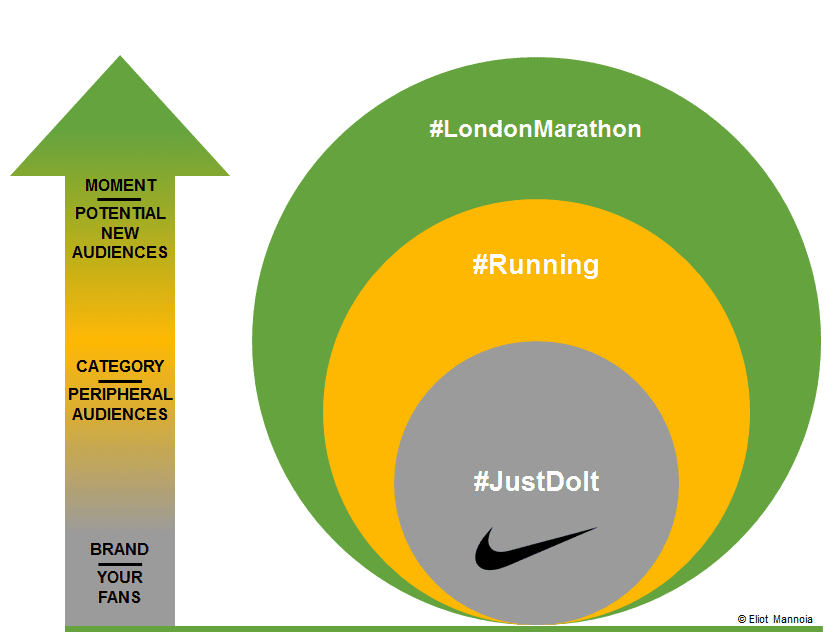
The three Hashtag types I would recommend (example Nike):

  1. Brand related (#JustDoIt)
  2. Category related (#Running)
  3. Moment/cultural (#LondonMarathon)

3 types of hashtags

You can read the rest of Eliot's blog on his site, and follow him on Twitter.


source http://www.smartinsights.com/social-media-marketing/twitter-marketing/the-3-types-of-hashtags-you-should-use/

Monday, 26 December 2016

The Rise of Ad-Blockers [Infographic]

How Marketers and Publishers Can Tackle the Issue of Ad-Blockers

Ad blocking software is great for internet users, but it can be a giant problem for both advertisers and online publishers. When ad blocking software is installed, both display and pop-up ads are prevented from being served. When this happens advertiser’s potential views or CPMs (cost per thousand impressions) are negatively impacted.

Most ads are typically paid for only after they’ve been served. This means that publishers aren’t paid for visits from any browser that has an ad-blocker enabled. Ad blocking is projected to cost publishers nearly $22 billion in 2015 with publishers losing almost 10% of ad revenue due to ad blocking. This number increases as high as 50% for some websites with teach-savvy readerships. As you can see this is a big potential loss for publishers for something that is outside of their control.

The use of ad-blocking software is on the rise as well which spells more bad news for advertisers and publishers. Nearly 200 million people now regularly use ad blocking software which is a growth of 41% over the past year. All hope is not lost however. Signal, a leader in cross channel marketing technology has put together a really useful infographic that offer’s actionable advice for both publishers and advertisers on how to deal with ad blockers and how to rescue your CPM’s. Take a look at the infographic below for more information.

AdBlocking-Signal-infographic

Thanks to Signal for publishing this infographic


source http://www.smartinsights.com/advertising/rise-ad-blockers-infographic/

Friday, 23 December 2016

The Top 3 Marketing Trends for 2017

What are the most important marketing investment priorities for Smart Insights members for the year ahead?

Each year, we ask Smart Insights members for their predictions of THE most important high-level digital marketing technique for their business or their clients. This has been really interesting to take the pulse of opinion on marketing trends across the main digital marketing techniques. Thanks if you shared your opinion, we had 2,352 responses from marketers around the world! Here are the results for 2017:

How the top trends were selected

From September to mid-December 2016 we asked readers of our post on Digital Marketing Trends for 2017 to select just one marketing tactic which would give them the biggest uplift in the year ahead. While this doesn't have a controlled sample of our free research reports like Managing Digital Marketing, it does canvas opinion widely.This isn't necessarily the most important channel by volume of leads or sales, rather it is the tactic which will give the biggest increase.

Note that the technique shown in the chart isn't necessarily the most important channel by volume of leads or sales, rather it is the tactic which will give the biggest increase in the year ahead. By asking for just one tactic, this helps shows the the top 3, 5 or 10 top-level trends.

We asked our members this question:

"Select one marketing activity that you think will give your business the biggest incremental uplift in leads and sales in 2017 (or your clients if you work for an agency or as a consultant)".

To help the decision on which to choose we expanded upon the short labels you see in the graph to help scope the example. For example, 'Big Data' is a nebulous term, but when we expanded it to include insight and

  • Big Data (including market and customer insight and predictive analytics)
  • Content marketing Communities (Branded niche or vertical communities)
  • Conversion rate optimisation (CRO) / improving website experiences
  • Display (Banners on publishers, ad networks social media including retargeting and programmatic)
  • Internet of Things (IoT) marketing applications
  • Marketing Automation (incl CRM, behavioural Email marketing and web personalisation)
  • Mobile marketing (Mobile advertising, site development and apps)
  • Paid search marketing, e.g. Google AdWords Pay Per Click
  • Online PR (including influencer outreach)
  • Partnerships including affiliate and co-marketing
  • Search Engine Optimisation (SEO or organic search)
  • Social media marketing including Social CRM and Social Customer Care
  • Wearables (e.g. Apple Watch, activity trackers, augmented reality)

You can read more analysis and details under each of these headings in my full article on Digital Marketing Trends for 2017.


source http://www.smartinsights.com/digital-marketing-strategy/top-3-marketing-trends-2017/

How Instagram can Elevate your E-commerce Store in 7 Steps

Example of how to harness Instagram to capture new audiences and convert that attention into sales

Instagram is one of the most effective ways to boost your e-commerce marketing. In a recent Yotpo survey of over 165,000 e-commerce businesses, 75% of them reported being active on Instagram. Customer research data is on their side. In fact, the research found that:

  • Traffic from Instagram is the most engaged: this means that visitors from Instagram stay on a site for an average of 192 seconds – that’s longer than visitors from every other channel, including Facebook, Pinterest, and Twitter.
  • 30% of Instagram users have bought something they first spotted on Instagram: meaning the potential for the browsing conversion to sales is high.
  • 83% of Instagram users reported that they were influenced by friend’s posting about a brand on Instagram: meaning Instagram is a powerful megaphone for your brand’s messaging.


Instagram attracts highly engaged customers and providing a giant signal boost for your brand’s message, so here are 8 ways to put Instagram to work for your eCommerce store:

Integrate Instagram user-generated photos into your website

User-generated content, UGC, is proven to be far more effective in catching the eye of internet shoppers.
According to a survey on user-generated photos, 77% of shoppers reported that they’d rather see customer photos than professional photos when making a purchasing decision.
In fact, 72% said that seeing Instagram photos of a product increased their chances of buying.

One of the best ways to capitalize on this is by harvesting customer Instagram photos of your product and featuring them on your product pages.
A recent A/B test of a major E-commerce company’s signature product revealed that displaying customer Instagram photos on the product page increased the product’s checkouts by 24%!

Inspire with creative hashtag campaigns and contests

Hosting a hashtag campaign or contest is a great way to encourage your customers to engage with your brand on Instagram. Here are a few tips to make the biggest possible splash:

  • Offer an irresistible reward: An exciting prize will definitely draw crowds. In the #Castmemarc campaign, Marc Jacobs offered a modeling contract to the user who posted the best photo with the tag. This not only generated a huge number of responses- 12,000 selfies in the first 24 hours, to be exact- but caught the attention of bystanders who were intrigued and watched the drama unfold.
  • Call on customer creativity: In the #PutACanOnIt campaign, Red Bull challenged customers to take photos of their cans in clever ways that made the can appear to be in unlikely places. Fun or unusual tasks that let customers get creative inspire customer engagement.
  • Go beyond product photos: While getting customers to take photos of your product has obvious advantages, it could pay off to think in a different direction. In their #withoutshoes campaign, TOMS donated one pair of shoes to a child in need for every Instagram pic of barefoot customers with the hashtag. These photos required that they not include the product - yet the buzz created for the brand was enormous, with over 296,000 links leading to TOMS.
  • Keep contest durations short: The internet moves quickly. Contests should be a week in duration or less. This inspires fast action and keeps things interesting for your customers.
  • Make sure your introduction is clear and compelling: Don’t spoil your own contest with a poor introductory post, such as a text-only image or an unclear call to action.

Create a Shoppable Instagram gallery

Instagram currently does not allow clickable links in photo captions, so the easiest way to sell directly through Instagram is to set up a shoppable Instagram gallery, which is a parallel site to which you link in your Instagram bio.
This link will take customers to an augmented version of the Instagram storefront, which contains clickable images that lead to different product pages where items can be purchased. You can also place checkout links in image captions.
The key benefit is that a Shoppable Instagram creates a direct link between your Instagram and product pages. Without it, a potential customer would have to search through your eCommerce store for a product that interested them on Instagram, which could cost you a sale - or a client.

Get Instagram Influencers on your side

Remember the 83% of users that said they were influenced by a friend’s Instagram post? That power is multiplied if you get an influencer posting authentic content about your brand on their Instagram.
Influencers can have hundreds of thousands and even millions of followers, garnering a similar reach to celebrity endorsement with a much lower price tag.
PuraVida bracelets are Instagram marketing pros, and their co-founders know more than a thing or two about the strategic use of influencers. They recently shared with Yotpo some key influencer advice:

  • Choose an influencer wisely: Gone are the days when just any influencer will do. Since UGC on Instagram is effective because it’s authentic, it’s important to partner with an influencer who truly fits your brand, enjoys your products and whose followers match your target audience.
  • Allow influencers to choose which products to feature: In the same vein, influencers will post more compelling content if they’re showing off a product they truly find valuable. Give influencers a choice in your product line so their reviews will be more sincere.

Place dynamic Instagram Ads

In addition to organic content, Instagram is also a strategic spot to place ads. Forrester reported that engagement from Instagram ads is 58% higher than Facebook ads and 120% higher than ads on Twitter. To fully take advantage of this potential:

  • Include reviews: Including a short review or testimonial with your image boosts your ad’s relatability and authenticity. According to Facebook, ads with customer reviews have a 4x higher CTR and a 50% lower CPA.
  • Use customer photos: The key to success on Instagram is to blend in, not stand out. Your ad should appear similar to the other posts in a user’s feed so it is not easily skipped over, and the best way to achieve this effect is to utilize the unique UGC you’ve cultivated from the steps above.

Engage with customers

An Instagram hashtag gallery on your website is one way to shift the spotlight to your customers and increase their brand loyalty. Such a gallery not only shows off your product being used in real time, but it also makes those featured feel valued by your brand and encourages their continued engagement, while inspiring new customers to get involved and connect.

Use your Instagram bio link

Your bio link is the only place on your Instagram that you can post a live URL, so make it count!

Here are a few ideas for making the most of your bio link:

  • Link to your shoppable gallery: If you have created a shoppable gallery as described above, your bio link is the perfect place to connect your two Instagram galleries.
  • Change it up: If you’re not using a shoppable gallery, alternate posting your homepage, your Instagram hashtag gallery, or a featured product, and mention the link in new posts. If you post an image of a particular product, include in the caption that a link to the product is in the bio.
  • Tread carefully: There are many websites that Instagram bans links to, such as competitors. Linking to another one of your social media sites, for example, would be risky. Do your research and check that your bio link won’t get banned.

Wrap-up

The numbers are undeniable, Instagram is a major game changer in eCommerce marketing. As you make Instagram work for your brand, remember these main take-aways. Your Instagram page should:

  • Inspire - The design and activity of your page, from Influencer posts, to ads, to a shoppable gallery, should inspire potential customers to create and share their own content around your products.
  • Feature - You should then feature the customers who deliver the most authentic and appealing content, inspiring those clients to participate more and tempting others to join in.
  • Engage - Take that participation to the next level by incorporating featured customer content on your website, and rewarding the best contributions through contests and special campaigns.

If you can achieve all three, your Instagram will not only boost your sales - it will create a dynamic, organic fan base which will only grow and attract new customers to your brand.


source http://www.smartinsights.com/social-media-marketing/instagram-marketing/instagram-can-elevate-ecommerce-store-7-steps/