Thursday, 3 August 2017

The top retail and E-commerce blogs

Our recommended blogs that every retail and E-commerce professional should be following to use the latest innovations and grow their sales

Considering the growth in importance of E-commerce, contributed to both by pureplay online-only businesses and multichannel retail businesses, it’s surprising that much advice on marketing best practices is ‘vanilla’, simply covering advice that could apply to any type of business. While some fundamental marketing concepts such as the marketing funnel and lifecycle marketing do apply across different businesses, many of the success factors for E-commerce businesses are specific to this sector. So, it can be difficult to find the best advice to inspire your improvements if you are new to working in the sector, or just want to expand your knowledge.

At Smart Insights we’ve been covering E-commerce and retail since we launched, and have a specific E-commerce toolkit for members, relevant for the main types of transactional businesses of retail, travel and financial services. We keep our E-commerce content up-to-date and we review a range of specialist E-commerce sites so that we can share the latest innovations and best practice advice on topics that matter to retailers, like merchandising and conversion rate optimization.

In this article, we’ll look at what we see as the must read sites if you work in retail. We’ve structured them by different types of advice starting with general E-commerce sites.

General E-commerce sites

  1. The E-commerce Times News Network. We start here since this is the Granddaddy; some of us remember it from the dot-com boom days of 1998 when it focused on tech stories, and it’s still running. These days it’s really broad, covering retail marketing techniques, but it’s still got the latest on tech issues like security and payment.
  2. Digital Commerce 360. This may be a new publisher to you, even if you’ve worked in E-commerce for a long time. The reason is that the venerable Internet Retailer (IR) has recently rebranded. As before, it’s US focused and covers developments by the main marketplaces and in different sectors.
  3. Internet retailing. The similarly named Internet Retailing focuses more on UK and European suppliers and examples, with the latest merger and acquisition news on European providers. It doesn’t tend to have so much analysis on practical best practices these days (plenty of these examples to follow).
  4. Econsultancy. Like Smart Insights this blog covers a range of sectors but recognizes the importance of retail and E-commerce, with examples of best practices in this sector.
  5. Smart Insights E-commerce marketing strategy channel. We’re well-qualified to write about this one. Our focus across the whole blog is on digital strategy and optimization. It’s perhaps no surprise, given our name, that we also share compilations of KPIs on performance benchmarks that are of interest to retailers, such as Desktop vs mobile E-commerce conversion rates. 

Best practice advice on E-commerce

Many of the best sites on getting better results from E-commerce are from vendors. Here’s our pick.

  1. Practical Ecommerce blog. We naturally thought of this blog first in this section. It’s been around, nearly as long as the E-commerce Times. We like its main channels which are Marketing, Conversion, Management, and Design and Development. Be warned though that some of the articles can be quite thin and aren’t necessarily specifically on E-commerce specific issues.
  2. Shopify blog. This is a well-known E-commerce platform and well regarded practical blog for retailers to learn from. Naturally, it does tend to focus on smaller SMB retail topics and examples of using its own platform.
  3. Big Commerce. This is one of our favourite blogs on this list. The reason? In-depth content on retail growth strategies, with examples. Its categories tick all the boxes of the topics that matter: E-commerce design, E-commerce marketing, how to sell online, online payments, and shipping and fulfillment.
  4. Practicology blog. We’re recommending this since it has a firm focus on retail improvements, from a consultancy specializing on E-commerce.
  5. Blue Leaf blog. This is another specialist, in this case a design and platform implementation vendor. They have relatively few blog articles; instead, here I’m recommending them for their quarterly ‘Inspiring Great Retail’ series, available in print, which we find useful for examples of the latest trends.

Blueleaf blog

Operations-focused blogs on cross-border commerce, marketplaces, payment and fulfillment

PayU blog

  1. PayU blog. As an alternative payments provider, PayU naturally covers the topic of payments, with a strong focus on best practices for cross-border eCommerce. (Note that PayU is a content partner of Smart Insights and commissioned us to compile this round-up, but all viewpoints are our own.)
  2. E-commerce Expo Insights. This blog covers topics from one of the largest European events on E-commerce, including payment, fulfillment, and marketing.
  3. Flex E blog. With discussion and examples of the latest models in fulfillment, this blog focuses on the US market.
  4. Tamebay. This blog has intelligence and news for all businesses and business people who want to improve their use of online marketplaces.

Stories to inspire start-up retail entrepreneurs

In this final short section, we look at a different type of blog which is more personal since they’re from owners of businesses explaining how they have grown them.

  1. E-commerce Fuel. Different from many of the other blogs we have featured, E-commerce Fuel is described as a ‘private community for 6 and 7 Figure store owners’. It also has a blog covering how to manage the growth of SMB E-commerce blogs.
  2. E-commerce Nation. This is also a community with different writers covering conversion, design and other advice including fulfillment, cross-border and M-commerce.
  3. A Better Lemonade Stand. This blog has a nice domain name and in-depth articles with strategies owners can use to grow their retail store.

A Better Lemonade Stand Blog


source http://www.smartinsights.com/ecommerce/ecommerce-strategy/the-top-retail-and-e-commerce-blogs/

5 Best Content Marketing Tips for Efficient Marketers

How to better results from your content marketing

Content marketing has recently risen to a position of prominence within the industry. As the creator of what is viewed, liked and shared online, it is one of the prime movers of any brand or product. Filling up the voids around the all-important keywords, content adds substance to any marketing strategy and, therefore, it cannot be ignored.

As content marketing has become essential, it has also reached a high degree of professionalization. Those who engage in it no longer dabble with words and information, but consciously create powerful cocktails of useful content and subtle advertising. The next 5 tips can be found in the arsenal of any efficient marketer.

1.    Content is re-shareable

One of the most time-consuming elements of content marketing is that it constantly requires unique and new content, even on topics that have been looked at and written about many times.

While it should always be novel, it is important to distribute the same content on different social media and online platforms, forums, blogs and pages. In this way, the customer reach is greatly enhanced and the resources are put to good use.

Even on the same platform, such as Facebook, some content – particularly infographics – can merit a re-share if they have gone unnoticed the first time around. Over time, the same topic or article can be shared with minor changes in the formulation of the title. With this occasion, efficient marketers can run a small A/B testing procedure on their audience in order to learn more about the individuals composing it and the things to which they react. However, this cannot be a regular practice at it would hurt the overall opinion that customers have of the page or blog.

2.    Exclusive content

Receiving some kind of special treatment is appealing to humans psychologically. In marketing, that comes in the form of exclusive content. Any site attempts to produce unique content, but usually the topic and the method of approaching it is common. Exclusive content, by comparison, beyond being professionally made or written, shows true creativity and out-of-the-box thinking.

By targeting consumers and addressing in particular to those that are or have the potential to be high-paying consumers, marketing managers earn their living. Exclusive content is also a method of rewarding them.

Source

Exclusive content can be research, infographics, images, how-to guides or videos. The essential feature is that they cannot be found anywhere else. This type of content does not need to come in bulk. If anything, wide availability hurts its status as “something special”. Instead, efficient marketers use exclusive content as an addition to their main pieces.

3.    Related resources

Content does not exist in a void and marketers should not behave like it does. One of the most common mistakes that content creators do is attempt to satisfy every need of their audience in terms of demanded content. This creates an enormous stress that is placed on the creative capacities of any marketing team, as it is required to continuously pump out high-quality content in order to appease its customers.

For that reason, efficient marketers have turned to content curation, meaning the active search of content that is related to their own. In this way, they are able to supply their audience with enough content and information without having to do it themselves.

Content curation brings benefits to the marketer and the customer alike. Spared the effort of creating similar but unique content at a constant rate, the marketer is free to devise new strategies and new types of content. At the same time, the customer is satisfied by the amount of information available and even appreciates finding out about products and topics he or she never considered. For example, an online shoe store that runs a blog on outfits, with recommendations and reviews, can link its viewers to another blog that deals in outfits and style. Together, they complement each other and better cater to the customer’s needs.

4.    Content for mobile

Smartphones are the new way in which people surf the web. As a result, the demand in mobile-friendly content has soared, with search engines even “punishing” websites that are not in tune in the mobile format. The way in which consumers ingest content is extremely versatile, across multiple channels.

One way in which to stay on top of the wave of mobile internet usage is by using Google Trends to establish what customers want locally. Geo-tracked, mobile usage offers more information to work with. Moreover, consumers that access a site through their smartphones or tablets have a higher bounce rate than desktop visitors, meaning that they more likely to respond to backlinks and other digital “breadcrumbs” within any form of content that leads to a product.

5.    Importance of UGC

Companies that deal in the service industry, such as hotels, restaurants or travel agencies, live by UGC, or user-generated content. Aside from reviews, the photos, videos and comments that fans leave on every piece of “company content” means a bump in popularity.

Source

Receiving high levels of user-generated content means that a certain brand is responsive and connected to its customers. In turn, they expect to be able to connect with brands through social media. As such, a company that is distant to its fans cannot succeed in the long term.

Twitter is perhaps the best example of UGC. The whole point of the platform is to follow others, and that is what companies are after. Any re-share or re-tweet stands for another endorsement and promotion of a brand and its products. As 59% of all respondents look to social media for recommendations before purchasing, with percentages only increasing when a younger sample of the population is used, UGC will become more and more important.

By making use of these 5 content marketing tips, marketers and content creators everywhere will be able to retain more of their viewers and to convert them into paying customers. Beyond conversion rate, they will obtain traction and wider internet coverage, particularly on social media. If content is king of marketing, doing it efficiently can only lead to growth and more income.


source http://www.smartinsights.com/content-management/content-marketing-strategy/5-best-content-marketing-tips-efficient-marketers/

How do you know when you need a website redesign?

A quick guide to achieving your website's full potential

"Is my website working to its full potential?” This question can be tough to answer because it depends on what you consider the ‘full potential’ to be and how your website is aligned to your company’s strategy.

Research by the University of Stanford shows that 75% of users judge the credibility of a company based on the professional look and design of their website. So how do you know your website needs a redesign?

There are some tell-tale signs that make you understand if it’s time to refresh your website. Here are our 4 signs that tell you your website needs a redesign.

1) Your company grows and the website is not aligned with your strategy

Depending on the industry and company, sales, finance, customer support, product development and digital marketing form all part of the strategy. For most companies digital marketing has the potential to become the first revenue generation tool but not without a professional website. When you notice that your website is not generating new leads, doesn’t attract relevant traffic and doesn’t contribute to the overall business development of your company, then it’s time to refresh it.

A brand is not just a logo and a tagline, it’s also the overall identity. And your website is part of your online presence and identity. So your website should reflect what the company is all about and how it evolves.

Company’s objectives, products, offers, services, offices...they all change and your website should reflect this.

Here is one example of a website redesign that created a more up to-date identity as the company evolved.

Before the redesign

screamingfrog.com website (before)

After the Redesign

screamingfrog.com website (after)

2) Your audience is more demanding than ever

Your audience becomes more and more technological and digital savvy with time. This means your website can’t be stuck in a design and user experience that is 5 years old.

First of all, with the rise of inbound marketing and the creation of quality content that pulls people towards a company and its products, a website should not only be able to accommodate but also to drive lead generation online.

Inbound and Outbound Marketing

Salespeople were once busy with outbound calls and emails looking for clients everywhere to close contracts. This is still the case today, but research from Hubspot has shown that 38% of salespeople have more difficulty getting a response from prospects. This is because users spend more time online to research a company and if your company doesn’t have a strong online presence, you miss tons of opportunities to generate new leads.

In practical terms, this means your website has to be structured for new pathways. It needs to be able to accommodate new content, highly converting landing pages and captivating design in order to meet the expectations of carefully built buyer personas.

Users want to find what they are looking for quickly and easily.  If they can’t download a document, read an article or buy a product within 2/4 clicks they become frustrated and leave. a redesign is needed to include better navigation, better engagement, more internal links,

In these instances, a redesign is needed.

A redesign needs to include:

  • Effective navigation
  • Higher engagement
  • Increased internal links
  • Effective converting landing pages
  • Better call to actions
  • More desirable quality content
  • More desirable user experience.

3) Your website is not mobile friendly

On the 21st April 2015, Google updated its search algorithm that’s designed to give a major boost to in search rankings to websites that are mobile friendly.

Research shows that mobile internet usage is on the rise. This means that it is more important than ever for businesses to migrate their online activity to be mobile friendly.

And, more recent research shows a steady increase of mobile devices: 60% of users now prefer tablets and smartphones, while 40% prefer desktop. Apps today are driving the majority of media consumption activity, now accounting for 7 out of 8 minutes of media consumption on mobile devices.

Digital media time

Google boost rankings for mobile friendly websites due to the rise of mobile devices. It’s no longer the case of asking whether mobile marketing is important, we know it is!

4) Search rankings are low

There are more than 200 factors Google and Bing use to determine a website's ranking and these factors change on a regular basis. This means that, if you want to be ranked on page 1 of Google, your website needs to be SEO optimized both internally and externally. Quality content, HTML optimizations, images, internal and external links are just some of the 200 factors that Google examine when crawling your website.

According to Search Engine Journal, 93% of every online experience starts with an online search. You cannot afford to be missing on that many potential visitors.

Thinking ahead

Your website is an investment for the future success of your business. Make your website aligned with your company's overall strategy being more SEO and mobile friendly to engage potential customers.

You can also try Smart Insights' new Quick Win on how to improve your homepage effectiveness.


source http://www.smartinsights.com/user-experience/website-redesign/how-do-you-know-when-you-need-a-website-redesign/

Amazon launch a shoppable social network called Spark

Amazon introduces a shoppable feed of stories and photos aimed at prime members

Amazon has launched Amazon Spark, a new feature aimed at improving product discovery. The idea behind the platform is to bring some of the social buzz that goes on beyond the website into the Amazon app. But here's the catch - it's only available to Amazon Prime members.

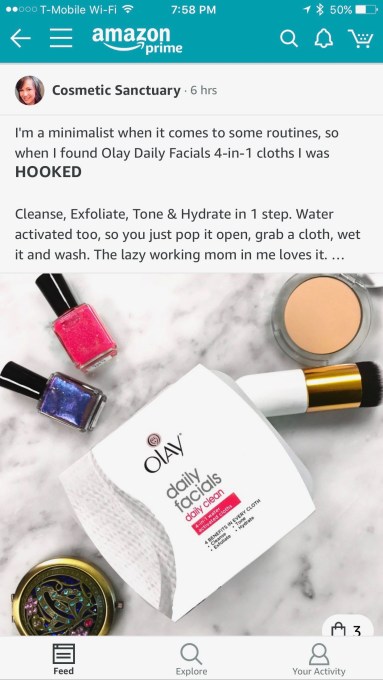
Many have said the platform was inspired by Instagram and its use of shoppable photos. Users are able to post stories, ideas, and images of products they like, which others can react to with comments and like.

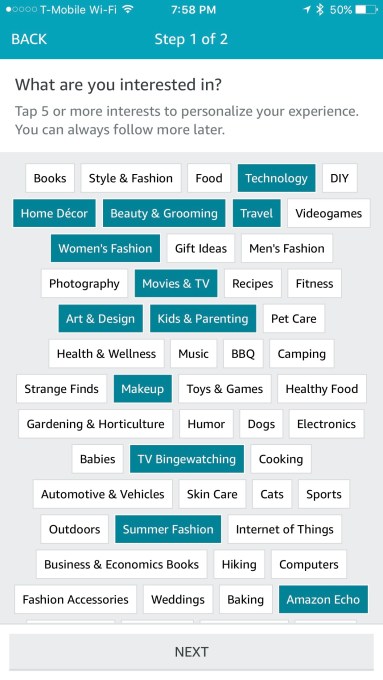
To access Amazon Spark, you have to use the Amazon mobile app. When you join spark you tell it your 5 top interests so Amazon can create a customized feed for you. There are also a number of niche categories you can select to further define your personal interests.

Once you have set up your account amazon will pull your own personalised feed with products and reviews.

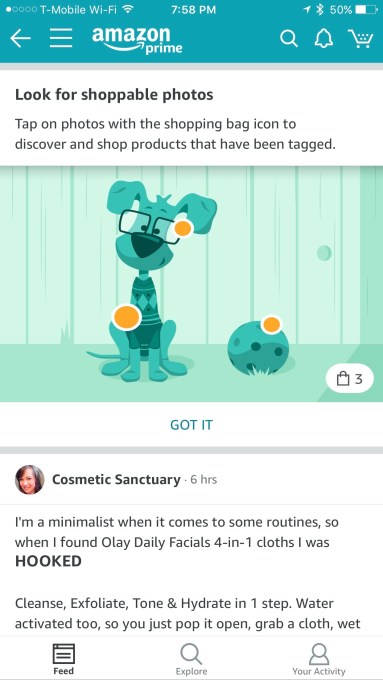
The feed will also feature images featuring Amazon photos where you can shop the image - similar to Instagram. There will be a shopping bag icon in the bottom right corner with a number that indicates how many items from the photo can be shopped on Amazon’s site.


Marketers and retailers should start to look at Amazon Spark as the key place for product reviews. Amazon is clearly trying to move away from rewarding top reviewers and instead reward the people who are enthusiasts for your products. They will receive a badge, which appears when they post to Spark or write product reviews. This gives prime users the ability to influence other shoppers as they are recognized as reliable and loyal.

Amazon Spark has launched this app to help people discover new products they might like to buy easily and all from within its app. It also provides a social network for customers to have their own profile, followers, feed and the ability to comment or like posts and products.

Tech Crunch suggests that as the new platform develops users will be able to generate some sort of income via their Spark postings. Allowing them to make money from product suggestions posted to Spark.

Amazon Spark is currently only available in the US but will be rolled out in the UK in the coming months.


source http://www.smartinsights.com/digital-marketing-strategy/amazon-launch-shoppable-social-network-called-spark/

How To Build A Successful Remote Marketing Team

7 Secrets Of Remote Team Collaboration

The ultimate goal of every small marketing business or a large corporation is to build a team culture where productivity will thrive and where all people are tied to the belief that “none of us is as good as all of us.” If you are sharing an office with a couple of people, with your mind set on one thing only, you become a part of a flow and the culture naturally happens.

However, if you are miles away from your marketing team, building a culture and becoming a part of it doesn’t just magically happen. While there’s no doubt that remote working is a growing trend, the question still lingers:

How to build trust and leverage the way marketers work together no matter where they are or what time zone they belong to?

Here, we’ve rounded up a few ways how you can build a vibrant working culture even if your marketing team is hundreds of miles away from you.

1. Use the right technology

The principal charm of working in an office environment is that it gives you the ability to feel how your marketing team reacts and feels about even the most trivial things that happen during the day. In other words, just by being surrounded by people helps you build their trust. Since working with virtual marketing teams lacks this essential feature, it’s imperative to create a virtual office that will help you avoid any traps of miscommunication.  

Mark Mortensen at Harward Business Review suggests focusing on the criteria that shape your daily routines and choosing the tools that are simple, reliable and accessible. With a plethora of applications available on today’s market, this may be easier said than done. However, if you focus on the technology that allows you to communicate with your marketing team in real-time, you are on the right track.

When it comes to virtual chat, most successful remote marketing teams use Slack or Hipchat to report on the performance of the content or any special marketing project. As for virtual meetings, a video chat like  Google Hangout will help your team have weekly content team meetings where they can review the editorial marketing calendar with product marketers or designers.

2. Build relationships through initial in-house time

One of the common challenges of being a part of a marketing remote team is an inability to feel connected with your employees. According to Google’s Project Aristotle, the most successful teams are the ones that have a higher level of understanding how their fellow team members feel. While using a video chat and video call is the core of successful virtual team collaboration, there is no substitute for face-to-face communication.

Here, at our company, we introduced new content writers to the rest of the marketing team by letting them spend three months in-house before they started working remotely. This not only helped them feel the energy of the marketing team culture, but it also helped them create social sensitivity and get immediate and constructive feedback on their works. 

3. Hire culture-fit people

To be able to build a real marketing team culture you need to have the right people. Besides focusing on creating a highly collaborative marketing team, you need to include a few more principles in your criteria. The fact that your marketing team is geographically dispersed around the globe makes it more difficult to physically manage them and keep track of what they are doing. In such scenario, the only thing you have to rely on is their personality and attitude to work. In other words, you need to hire remote marketers who are organized, motivated, autonomous and who don’t care about social facets of a workplace.

4. Demand feedback

Another thing you need to keep in mind is communication. Ann Macdonald, director of a content strategy at LovetoKnow, says that staying in touch and working through challenges is much easier if the people on the marketing team are communicative. Whether you’re discussing a minor problem or a serious issue that your team may come across in large marketing projects and campaigns, it’s important to constantly encourage your employees to give feedback both on their progress and barriers they run into.

To keep the communication flow at the highest level, combine communication mediums such as video conferencing, 3D environments and telephone calls. Instead of relying completely on virtual chats, organize a weekly video conferencing and allow your marketing team to measure the results of their marketing effort by sharing their ideas or pitfalls they have to tackle. Jake Goldman, a president and a founder of 10up Inc., points out that remote employees need to over-communicate to compensate for reduced face-to-face time.

5. Make clear and transparent processes

When working with freelance writers, PR agencies and social media consultants, online chat is an effective medium of communication. However, the lack of physical contact and face-to-face communication may result in misunderstanding and create a serious bottleneck in your marketing team’s workflow. To avoid such a scenario, you need to keep your team regularly updated and keep your processes transparent at real time. Your marketing team needs to have a clear understanding on the why and the how and the when and they have to be aware of each other’s priorities.

Besides organizing periodic virtual meetings, consider investing in a simple and efficient project management tool. It will clearly define the roles and responsibilities of each team member and create a culture of open communication. Joel Sposky, the CEO of Stack Overflow, uses a technique of emailing updates on weekly basis. He explains that every Monday, everyone at Stack Exchange emails their manager a status update of what has been done the previous week and what kind of challenges they had to struggle.

6. Create a culture of productivity

There’s no doubt that collaboration and productivity are tightly connected and heavily dependent on each other. The healthier the working environment is the more productive you are, and the other way around. Collaboration fosters creativity. Studies show that the most powerful research papers are often the result of “not so bad” ideas made ingenious by group work. In other words, being an integral part of any discussion like weekly content planning and contributing to the brainstorming process in your weekly content team meetings is the key to efficient team collaboration.

By sharing your thoughts on how to increase your brand’s awareness and laying out the ideas that have been swarming in your head you are likely to become more motivated to work towards positive results. There is a wide range of chat tools like HipChat that allow your team of marketers to brainstorm their ideas, comment on them and reach the final decision no matter what their location is.

7. Develop an efficient work schedule

When working remotely, time differences have a huge impact on the general workflow and the dynamics of the team. Besides being geographically dispersed around the globe, the members of the remote team share different time zones and don’t necessarily have to be at the computer at the same time.

Timeshifting is a mandate if you want to coordinate work across your marketing team more effectively. Adjusting your work hours to better sync with your team’s working hours will allow you to interact. Your marketing team can either choose a one time that bridges various time zones or break up their day and spread out time into intervals rather than doing it all together. Also, encourage your team to work at least one week in advance on anything content-related. This way they will easily keep track of their content marketing strategy.

Finally, praise your colleagues. By singling out colleagues for their achievements and sending thank-you emails publicly will boost your remote marketing team’s morale. Stimulate them to feel a common goal and work towards achieving it.

Long are the days when business was viewed as a purely chronological system where face-to-face communication was the foundation of successful team management. With the technological craze that has been taking the world over the last decade, more and more companies are shifting from traditional office environment to remote work. Studies show that remote business model grew by almost 80% between 2005 and 2012, and we are still experiencing its massive impact on business culture in general. Even some of the cutting-edge marketing companies who exclusively operate with geographically dispersed teams have proven that working remotely will be the future modus operandi.


source http://www.smartinsights.com/digital-marketing-strategy/how-to-build-a-successful-remote-marketing-team/

Wednesday, 2 August 2017

Rolling AdWords like a professional basketball player

PPC tips and strategy to enhance your AdWords campaign

What comes to your mind when you think about AdWords? Perhaps, a lot of data, excel sheets, and analysis. When I think about AdWords, I usually think about a customer’s choice and their range of options, as if they were buying a burger at McDonalds.

Economists put goods that are likely to sell well together and called them complementary goods. McDonalds uses this approach to sell burgers and chips as great complements. How many times have you bought a burger without chips at McDonalds? Probably never.  The same theory applies to AdWords search and display ads. If you have search you should have some sort of display advertising. These are ideal components of advertising that complement each other so well and almost guarantee a great outcome.  However, I won’t be able to go too far with my food theory on AdWords advertising so I will try out some of the most known basketball strategies on a battlefield of AdWords competition.

“Alley-oop” Search & Re-marketing

There are a lot of advertisers who don’t use remarketing and search to their full potential. Search and remarketing make an ideal duo and contribute to amazing outcomes and campaign performance. Let’s imagine search ads as the player who makes a long-distance pass close to the rim of the basket and re-marketing catches the ball and dunks it.

This is how search and remarketing work together:

  1. A user searches for a product
  2. Clicks on your ad
  3. Doesn’t convert, leaving the site – the ball was close to reaching the basket
  4. Remarketing takes over and serves the user relevant ads across other websites
  5. Eventually a user clicks on one of these ads, leading to a conversion – the ball is in the basket. Well done, great job!

AdWords further improved the options for those who prefer using search advertising with RLSA, introducing the ability to use remarketing list for search ads. Once your audience is big enough, your team is ready to play the game. I would strongly recommend RLSA to all advertisers who are limited in their ad creative.

The data below shows how introducing a remarketing campaign in May 2016 initially brought instability and cost increase, but over time the CTR and conversion rate improved. The result was better than before retargeting with cost and CPC decreases with average position remaining at the top.

The choice is yours, however, do not underestimate the “Alley-oop” strategy.

Fast Break

The fast break strategy in Paid Advertising is not always the best way to approach AdWords. In basketball, it is an offensive strategy that involves moving the ball up the court as fast as possible before the defense has had time to set up. I refer to fast break strategy in Adwords as the initial stage of setting up the campaign where you choose the bid strategy, ads in rotation and so on.

Fast Break

Let’s say the campaign is set up with enhanced CPC, accelerated delivery, and ad delivery optimized for the best performing ad.

Enhanced CPC allows Google to pay more so you appear higher for a highly converting user. Accelerated delivery means that your ads are hyper-competitive and appear for every search with the top performing ad being seen nearly 70% of the time.

Unfortunately, the reality is that accelerated delivery aims for spending the budget faster throughout the day, while enhanced CPC further increases your bids based on an assumption that a user may convert. On top of this, ad rotation leaves you without an opportunity to see which ads perform better, because generally, only 1 ad will outperform the rest of them. At the end of the day, you will be left with a lot of unreliable data, unnecessarily high CPC, and an exhausted budget.

I strongly recommend letting the campaign breeze along, letting it collect data, rather than trying for a fast break.

Triple Threat

Triple threat is when the player has just received the ball and has the options to dribble, pass or shoot. Let’s think of an AdWords campaign that you have recently received from a customer, or a fresh campaign build, as a triple threat. It can go either way, and it is necessary to set the basics right. Think about very important features such as use of broad match keywords, negative keywords, overbidding, poor campaign structure, and ignoring the time of day.

When the new campaign is built, it needs to be checked daily until you are absolutely sure that there is no chance for things to go sideways.

Sixth Man

In basketball, the sixth man is the first non-starting player on the bench who is considered more valuable than the other reserve players. It’s time to talk about the business that we are advertising. It’s crucial that we don’t underestimate the power of the business itself. Our job is to make sure that the business model and goals are well-understood and baked into the strategy of the AdWords campaign. The business’ development is indirectly affecting the campaign as well as the team effort is what counted at the end of any game.

Also, we should not forget about the power of AdWords’ new tools and optimization strategies. Never miss a chance to try new strategies, new opportunities, and utilize new features once they are available (of course, only if applicable). If there is a chance, make sure you make use of AdWords betas.

Pick and Roll

Imagine a player running across the court, facing a defender, who is unaware about being blocked by a team mate of an offender, then our player “rolls” over and the defender is left thinking whether to pursue an offender or switch to another player who blocked the way. How can we ensure that our campaign is well protected? Never leave your campaigns with a limited budget. This is the time when your campaign is set to be perfect and it functions as an offender.

However, with a limited budget, or sick team member, the options become limited, and that “pick and roll” moment may never happen. You will miss a lot of opportunities to show your products and even miss out on a potential sale or lead. In the scenario where your campaign already has the necessary keywords and appropriate ads, the ball is in our hands and having enough budget helps to carry the ball until the end of the game.

Are you at a loss with your PPC campaign? Try Smart Insights' Paid Media toolkit to get your business started. This will help you increase your online reach and awareness using targeted paid media. Not only that, find out about best practices to improve your ROI using Google AdWords, Social Media and display Ads.


source http://www.smartinsights.com/paid-search-marketing-ppc/paid-search-strategy/rolling-adwords-like-professional-basketball-player/

Do you use templates for your emails?

Chart of the Day: To code or not to code? (Technology) - Part 3 of 6

We are now half way through our six-week series on email workflow. So far we have discussed Planning and Time spent on tasks. Last week I asked in a poll, "for each email that your company sends, which task takes you the longest?" View our results and find our which task takes you the longest.

This week we will be looking at what companies mostly used for the creation of the emails. There are two options - you can either use an email template or use HTML and CSS coding from scratch. Firstly, let's look at what an email template is.

Email templates - what they are and why you should use them?

An email template is a pre-formatted and reusable HTML file. When you load the template, it will allow you to edit the areas that are pre-defined.

There are some really good reasons why you should use templates for your email:

  • Keeps the email marketing consistent in brand and formatting
  • Allows for quick email creation
  • Allows less experienced email marketers feel more confident creating emails.

Email Marketing Template

In the chart below, we can see that 31.4% of the respondents will either create new emails by replacing the text and image coding in their template or by copying and pasting the code of previous emails and updating the content. The other three options which vary from 20.9% - 16.9% use templates in one way or another.

The lowest and unsurprising of all, are those respondents who code all or most of their emails from scratch (10.3%). Now, don't get me wrong, I am a self-professed email geek and love nothing more than creating an email from scratch (love a bit of CSS). Also, remember fifteen years ago we had to do it that way. Thankfully technology has moved on. But, we live in a commercial world and email marketing is generally underfunded. So we don't have the luxury of time to create each email from scratch.

PS: Do you know what WYSIWYG is? It is an acronym for "what you see is what you get". It allows you to see what the end result will look like while the email is being created. Personally, I hate these editors and I prefer to edit the code. I do this because it keeps my coding skills current but also because some of these editors format emails differently. I am an email geek after all.

Coding or Templates?


source http://www.smartinsights.com/email-marketing/email-creative-and-copywriting/use-templates-emails/