Tuesday, 3 October 2017

4 Ways to Create More Effective Digital Marketing Content

How to get enhance your content marketing for higher engagement rates

As the tools and channels that make up the digital advertising ecosystem continue to evolve and grow more diverse, it seems many brand marketers and agencies are feeling left behind. A recent study by The Boston Consulting Group found that advertisers gave their own digital capabilities a 57 out of 100 on average. For context, that average score is exactly the same as in 2015.

So what’s going on?

Some advertisers who participated in the study blamed inadequate marketing technology platforms for their lack of results. Some pointed to the prioritization of other programs within their organizations as an obstacle. But there was one area where the majority of marketers felt especially lacking: their abilities to map consumer journeys and tailor content to match the various touchpoints along those journeys.

That’s a problem.

Above all else, the success of your digital strategy depends on your ability to understand your customer. That understanding is what allows you to deliver the right content at the right time through the right channel.

content marketing

Get to Know Your Customers

Customer journey mapping is a complex process that technology can actually make more difficult in some ways. Many advertisers have no choice but to try to derive insights from data that’s scattered across a number of reporting platforms, analytics tools, and departments, some of which might even lie outside their own organizations. If this sounds like you, the first thing you should do is consolidate that data. Put it all in one place before even attempting to analyze it.

Oftentimes, consolidation means data must be shared across departments and partner firms, which leads to another important point: Whenever possible, partner with third-party firms to collect additional data on your customers. Analyzing data on customer interactions with your own digital properties is a good start, but it’s not enough to give you a complete understanding of their online behavior, as the vast majority of their online activities occur elsewhere.

Likewise, don’t place too much emphasis on vanity metrics such as page visits and views. Instead, pay attention to customer actions. How do they navigate your website? How many product pages did they view before leaving?

Traffic counts might make you feel good, but they won’t tell you much about what makes your customer feel good. When you’re trying to create an accurate customer journey map, your customers — their intents, motivations, and pain points — are all that matter.

Put Your Knowledge to Work

A thorough, data-driven journey map is only half of a sound digital marketing strategy. To really drive results, take advantage of what you know about your customers to create and deliver content that compels them to action. Here are four steps you can take to make that process easier:

1. Let customers dictate content.

When you know a customer’s interests — whether they include a product on another site, a certain artist on Spotify, or a specific show on Netflix — you can incorporate into your own content the language, imagery, and feelings that draw them to those interests.

Modern marketing technology allows advertisers to deliver personalized, engaging content that can create stronger bonds between customers and brands. By providing customers with content that resonates with them, you’ll often be rewarded with loyalty and further engagement.

2. Segment audiences by touchpoints.

Segmentation allows you to execute any marketing strategy more efficiently. By segmenting customers on the basis of where they are in the customer journey, you can determine what type of content is most likely to keep them moving forward.

For example, if you’re a marketer at a personal finance company, you wouldn’t want to target a customer with messaging about home mortgage refinancing opportunities if he or she has viewed only your checking account sign-up page. That might come later, but it’s not relevant now. When you deliver the wrong messaging, you not only waste resources, but you also run the risk of alienating potential customers.

3. Create a lead scoring method.

Make sure each interaction along the customer journey is accounted for with some type of scoring system. For example, you might attribute one point for a product page view, one point for a site search, three points for a transaction, and five points for multiple transactions, perhaps within the past 30 days.

Scoring leads allows you to segment them even further, which gives you a better idea of the content to serve them. Your goal should be to move as many people as possible into the highest-scored segment through more frequent emails, reaching out via social media, or targeting them with paid search.

4. Allocate resources on the basis of impact.

As you continue to learn about your customers’ behavior from their interactions with your content, incorporate those insights into your investment decisions. Your programmatic buys and other online efforts should get more effective the longer your campaign is in flight. Similarly, you should repurpose high-performing content and aim to maximize ROI from each piece of content you produce.

A sound digital advertising strategy is always customer-centric and data-driven. Whenever possible, avoid making decisions on the basis of assumptions. Unfortunately, marketers have very little room for error when it comes to reaching and engaging the modern consumer. Targeting potential customers with irrelevant or uninspiring content can make reaching those customers even harder in the future.

Instead, study customer behavior and take the time to map out a detailed customer journey and to produce the content that will move customers from one touchpoint to the next. And when you do make mistakes, make sure you learn from them.


source http://www.smartinsights.com/content-management/content-marketing-strategy/4-ways-create-effective-digital-marketing-content/

Twitter and their controversial 280 character limit

Twitter trials expanding tweets from 140 characters to 280

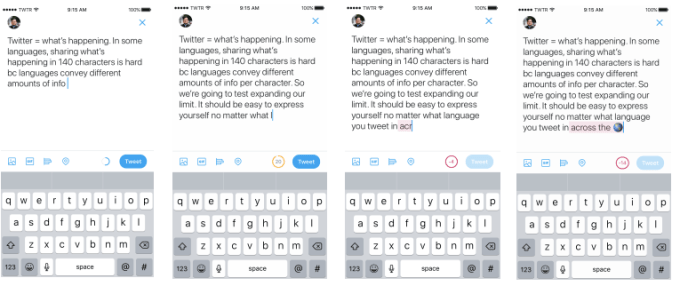
Twitter announced last week that for the first time ever it is expanding beyond its 140-character limit. This will be for select languages, including English, Spanish, Portuguese, and French, to allow users to share their thoughts without running out of room in the tweet. They will be testing this feature out on a small group of verified accounts, to begin with.

Their reasoning for expanding the character count was because, for those tweeting in some languages such as Japanese, Korean or Chinese, they require fewer characters than tweets in English or Spanish. Twitter explained with a graph:

'We see that a small percent of Tweets sent in Japanese have 140 characters (only 0.4%). But in English, a much higher percentage of Tweets have 140 characters (9%). Most Japanese Tweets are 15 characters while most English Tweets are 34. Our research shows us that the character limit is a major cause of frustration for people Tweeting in English, but it is not for those Tweeting in Japanese.'

Twitter believes that when people have more character they are more likely to tweet. But since the launch of Twitter, we have all kept within the 140 character limit and got our point across. For many, it is what makes Twitter so unique, taking away it's short and snappy Tweets it will become a lot like other social platforms. We have seen mixed (and funny) reviews of the change.

My thoughts - If you can't say it in 280 characters, don't say it at all. On the flip side, this feature is great for those who have more to say and require a few more characters to make an important point.

Techcrunch has reported that alongside this change, Twitter is also updating the user interface. It will no longer count down the characters until you near the end. Instead, you won’t know how many characters you have left until you reach 20.

It has been reported that test is not expected to last long before Twitter plans to make a decision regarding a broader rollout. What do you think of the 280 character limit? Let us know on Twitter and share your thoughts.


source http://www.smartinsights.com/social-media-marketing/twitter-controversial-250-character-limit/

How to prove the value of content marketing to your business

Content creation ideas to boost your audience engagement

After all, that’s precisely why your brand should be investing in content marketing. Ask yourself and your wider organization -  is this why we’ve decided to embark on a content journey?

It should be, it’s to build your own subscribed audience by researching, listening and creating or indeed curating content in whatever form that may take (blog article, graphics, video, presentation, slide deck) that answers the challenges to your particular audience.

Something where perhaps your brand can differentiate, reinvent and create a new opportunity in a crowded marketplace. In fact, content marketing continues to gather pace and a recent article by the CMI suggested that:

"Content Marketing will continue its epic rise as one of the most preferred options for both B2C and B2B marketers in engaging with their audience and prospects. In fact, a recent study by CMI suggested that 70% of B2B marketers plan to create more content in 2017 yet only 37% of B2B marketers have documented strategy in place"

This is a shock, considering the below recent survey from Econsultancy/Adobe suggests that Content Marketing is the key priority for B2B companies in 2017:

So the challenge of a successful content led approach requires organizations to adapt. The purpose of this post is you can prove the case of a content led approach.

It is critical to address the importance of content marketing because it has been hammered as a “tactic” that simply does not work.

And that’s because content marketing can’t be considered a campaign or tactic, it goes far deeper than that, it should be an opportunity, no matter your role or position in the organization, that acts as the enabler to bring your brand to life, connecting your business, your purpose, your very reason for existing.

Easier said than done right? Here is a great example from River Pools and Spa, a US based swimming pool business who were struggling to drive sales during the market crash in 2008-09. Rather than waiting for potential customers to visit his premises, Owner Marcus Sheridan decided to go to the customer by literally answering the questions and concerns of his audience.

Case Study: River Pools and Spa

River Pools used libraries of customer research, asked questions and brainstormed the major challenges and requests from customers to visit River Pools showrooms and engage via social media and the phone. Armed with this long list of intelligence, Sheridan set about turning this into content, content via a company blog that answered the most common questions people had about swimming pools.

By putting the customer at the centre of their strategy, the organization transformed and became a “knowledge centre” for anything to do with helpful advice for anyone considering a swimming pool.

So taking inspiration from River Pools and Spas, here are a few easy wins to consider in order to get your content marketing mission on the right path by first making sure what you’re writing stems from a challenge your audience has. But how do you find these challenges?

It’s all around you! I’ve pulled together a handy list of information you could use to re-purpose into content:

1. Company Slide Shares

Most companies have a library of slides and power points in shared files. The content on the slides has firstly been approved and secondly is going to be topical (at least it should be if it was used for a recent presentation). With some re-purposing into relevant blog copy you have the makings of 4 or 5 topical posts that would appeal to your audience.

1. Customer Service

Go and speak with your customer service team. What are the common themes and questions they are having to deal with from customers? This tactic can provide you with plenty of subject matter to create some suitable content.

3. Internal Search

Always a great indicator as to what users search for when they arrive on your desktop/mobile site. Not only should this be a KPI for UX teams but this again can provide you with some interesting topics and ideas to create content around in answering the most popular internal search queries.

4. FAQ Pages

Ah the somewhat dull FAQ page – The origins of such a page are a mystery but it’s a fantastic example of a simple example of content marketing that has been pulled together with a remit to answer questions and uncertainties of previous customers. Take a look at some of the questions listed on your pages and look to add some polish by elevating them into new content for your audience.

5. Competitor Sites

Researching your competitors can also provide you with some fresh ideas for content themes as well as it providing you with key content areas your competitors are focusing on to address the same audience as you.

For example, it could be content that enhances their products or services or seasonal/topic content themes.

To get a better steering on what your competitors have focused on sites, here are a few suggestions on 3rd party tools you could use to better understand what content is serving your competitors well:

Keyword Research - SEMrush can provide a wealth of insights into the type of content through search terms they are attracting.

6. Emails

Spend some time with your customer service team and listen in to calls they’re taking from customers as well as common themes and trends that surface from customer communication with your business? What can you begin to theme and categorize into subjects that would create helpful articles to assist your audience?

7. Corporate Events

Find out the upcoming events calendar for your business and where they plan to be running or exhibiting at any trade shows. If there is an opportunity to be included and use this as an opportunity to ask questions in the field. It’s an opportunity to survey and ask questions as well as listen to the concerns of potential customers at these specific events.

8. Interviews – Internal and Industry

No doubt your organization has a wealth of experience in the industry and there must be a few senior managers who have their own network of contacts as well as be able to provide their personal views and insights – these can be the makings of great content for interviews, videos and explainers that can be used to drive awareness into your industry and help position your brand as helping the audience.

9. Coffee Shops

Possibly the cheapest and most effective form of user research. Take your customers out for a coffee and ask them to explain their concerns and challenges and where/how your organization is set up to meet their challenges.


These are just a few examples that can help you begin to define and justify your organization's position as helping their audience with the type of content they want and need.

Putting the customer at the centre of your strategy is a cultural shift, but these examples of where you can begin to identify pulling together helpful content will begin to put your content marketing strategy onto first base.


source http://www.smartinsights.com/content-management/content-marketing-creative-and-formats/prove-value-content-marketing-business/

Monday, 2 October 2017

Ecommerce KPIs by shopper loyalty segment

Chart of the Day: Multiple purchase history customers have higher add-to-cart and conversion rate than single purchase history customers.

This is really not that shocking - returning loyal customers (8.55%) have a higher a conversion rate because of their previous experience with the brand.

A new shopper to an ecommerce site will have questions they want answering first:

  • Is this product reliable?
  • Is this the cheapest price?
  • Can I find a similar product elsewhere with better reviews?
  • How much is P&P?

Among others, it is also possible that first-time customers to your site are more wary about buying your product without social proof, or persuasive copy.

Returning customers are returning because they like your product, would recommend it and are happy with the quality and customer service - more new shoppers need to be converted into returning customers.

Monetate-E-Commerce-KPIs-by-Shopper-Loyalty-Segment-July2017


source http://www.smartinsights.com/ecommerce/ecommerce-analytics/98144/

How your mobile ROI can increase with Progressive Web Apps

Case studies showcasing the positive affects of PWAs

PWA technology isn’t exactly new, but it isn’t completely old either. However, as more and more internet users spend more and more time (as well as more and more money) via mobile applications, and because of the high and increasing level of mobile penetration globally, it comes as no surprise that the meteoric rise in popularity of mobile internet usage has led to more companies both big and small incorporating PWAs as part of their digital marketing strategy.

Two questions still remain, though: what exactly are Progressive Web Apps? And why have they suddenly become so popular?

progressive web apps popularity

To be able to better understand how things have gotten to where they are now, we should take a step back to look at some web development history.

History and background

The past decade or so (starting from around 2005) saw web development technologies slowly yet steadily shift from using static tools to using dynamic ones. A big part of this change included the implementation of responsive web designs in which web pages would render and accurately display web content regardless of the device being used.

However, a longstanding shortcoming of such web design methodologies was that they were never as good as native apps, primarily from an ease-of-use and overall user experience (UX) point of view. Native apps always proved better able to provide not just more seamless user experiences, but they loaded data and booted more quickly when compared to web apps, because web apps, at least for users who are faced with slow or patchy internet connections, generally have longer load and boot times.

Fast-forward a few years, and by 2010, continued enhancements in web technologies such as HTML5 and CSS3 significantly boosted the capabilities of web browsers. Concomitant improvements in mobile processors meant that performant hybrid apps that could actually compete with native apps were fast becoming a viable alternative.

In short, the technological changes that have taken place over the past decade or so in the online space have meant was that hybrid apps now more closely mimic native apps, and we have therefore seen companies and coders move from following a native app paradigm to adopting the PWA paradigm, if for nothing else then because they allow hybrid apps to function pretty much exactly like native apps while delivering true native mobile user experiences.

Additional native app functionalities found in PWAs also include things like sending push notifications, working offline, and basically looking and feeling like an app but running off the web.

Now that we know what PWAs are, we can start talking about what makes them so special. Let's look at two case studies of actual PWA implementations to get a better feel for how they are transforming the mobile industry.

Alibaba: raising conversions by 76%

Alibaba is the world’s largest online business-to-business (B2B) trading platform. It serves a very wide and diverse user base across over 200 countries and regions, primarily through the mobile web. As such, the mobile web has always been the focus of the company's design strategy. However, because web browsers are often limited in functionality, delivering an engaging experience for mobile users via web tools was problematic.

The company tried to shift non-app users to the company's native app, but many preferred to stay within their browsers. Further, having to download an app to browse or to complete a transaction was seen by users as an unnecessary barrier compared to the quick, easy solution of browsing directly from their mobile browser.

The solution that the company arrived at was to first understand how users used their services, and to then deliver a great user experience for both first-time as well as repeat visitors. The PWA built by Alibaba led to a fast, effective, and reliable mobile web experience that delivered a 76% increase in total conversions across browsers. Re-engagement figures were also up, and they were comparable to those of the native app.

The investment in PWA alone increased Alibaba's monthly active user rates on iOS by 14%, and on Android by 30%.

The Alibaba case is by far not the only one. Here is another one, this time from India.

Makemytrip.com: increasing conversions by a factor of 3

MakeMyTrip is India's leading travel company, and it boasts roughly eight million visitors every month. Over 60% of the company's users use mobile for bookings, and the company's native app has had over 20 million downloads, making the app a key component of revenue generation.

The challenge for the company, however, was that many potential users only have intermittent connectivity at best. Others are faced with data limitations and the shortcomings associated with using low-end phones. These factors make it difficult to drive users to download native apps, which can understandably lead to steep drop-off rates and high customer acquisition costs. To overcome these challenges, the company wanted to build an effective mobile presence to reach Indians in far-flung areas, those more likely to use low-end devices on slower networks.

Reaching that audience, however, required a solution that merged the benefits of native apps and those of the mobile web to effectively lower discovery costs while increasing customer engagement rates.

What MakeMyTrip did was build a PWA that led to a fast, reliable, and smooth mobile-web experience. Page-load times were reduced by 38%, and conversion rates on the PWA tripled. Along with a much higher overall conversion rate, the PWA led to a 160% increase in shopper sessions, and even bounce rates fell 20%.

Because there is need to install an app, and because the PWA works offline using cached data, users are now one click away from content. First-time shoppers are highly engaged, and the company was able to drive mobile traffic directly to the PWA, regardless of the OS of the device in use. The PWA has helped MakeMyTrip reach users in several new cities, and it has become the new standard for the company's mobile operations.

What can we learn?

PWAs combine the best of both native apps as well as the web and should, therefore, be seriously considered by anybody working in the online space. Furthermore, with numerous feature and functionalities that cater specifically to Android users (who make up over 85% of the world’s mobile OS market), your PWA strategy could potentially target millions of new users who may be missed due to app installation barriers or issues related to connectivity and coverage.

In short, PWAs can help companies overcome the following challenges:

  • Deliver a frictionless, native app experience without the associated costs of developing one
  • Provide customers with a functional yet light web portal that reduces data consumption, data costs, and load times
native mobile app vs PWAs

Source: AppInstitute

  • Improve user engagement and retention via push notifications; simultaneously increase the amount of time visitors spend on your website
  • Lower your per user acquisition cost while allowing for quicker growth ramping as compared to native apps
  • Target new users who face the ubiquitous challenge of a lack of connectivity

Summary

The latest tools and technologies have really enabled PWAs to deliver smooth and seamless user experiences, meaning it would be worth the investment to develop a mobile-centric environment for your company instead of modifying an existing website with a responsive design, or investing in a native app. By providing great UX at low cost, high engagement, and providing an easy to use alternative to an app, you can reach wider markets with PWAs. As long as there are users who are on the move or who are faced with limited or slow internet connections, the PWA will be here to stay, and they are sure to attract more and more attention and be a central part of the mobile strategy of companies operating online for a long time to come.

Thanks to Ian Naylor for sharing their advice and opinions in this post. Ian Naylor is the CEO & Founder of AppInstitute. You can follow him on Twitter or connect on LinkedIn.


source http://www.smartinsights.com/mobile-marketing/app-marketing/mobile-roi-can-increase-progressive-web-apps/

2018 Marketing predictions you need to keep an eye on

Seven predictions to act on for your future marketing plans

The start of 2018 is in sight, So, it’s the start of seasonal predictions about the forthcoming year’s marketing and branding trends.

In this article, I gaze into the crystal ball to make seven predictions relating to 2018’s marketing trends. These cover trends in audience engagement, branding and advertising. For more coverage of digital marketing, see Dave Chaffey’s Marketing trends 2018 article .

Prediction 1: Personalisation gets even more savvy

Marketers have long understood that consumers are preoccupied with one question: “what’s in it for me”?  Accordingly, personalization through the use of big data has become one of sales and marketing’s important campaign considerations.

Personalization

Stub Hub lists all my favourite artists and venues first

For example, StubHub, an online ticket exchange operated by eBay, reported a 42% improvement with a personalized call to action.  IDC forecasts that by the end of 2018, the big data industry will be worth $102bn.

On a practical level, many dynamic sites featuring smart marketing automation have superseded older static site content. (According to Smart Insights Improving Engagement Report 2018, dynamic content insertion is used by 4 in 10 marketers. However, some pundits warn of the danger when excessive personalization becomes less direct, it loses some of its potency. The good news is that digital marketers are fast to respond and adapt to consumer needs and fears. Therefore I predict that personalization will become more subtle, relevant and ultimately savvy.

Prediction 2: Pansexual Marketing

In July 2017, the UK Advertising Standard’s Association report, ‘Depictions Perceptions and Harm’ suggested harmful stereotypes in advertising limit choices, aspirations, and opportunities for children, young people, and adults. The guidelines require brands to adhere to new standards to replace hackneyed stereotypical gender roles and characteristics.

Fearless Girl, a statue in Wall Street created by McCann New York for State Street Global Advisors, is meant to encourage more financial companies to put women in leadership positions. In August, UK Clarks shoes came under fire for launching ‘Dolly Babes’ shoes for girls and ‘Leaders’ for boys. One month later, in a bid to eradicate gender stereotypes, John Lewis removed gender-specific labels from its children’s clothing.  (John Lewis also suffered a Twitter backlash).

Despite further anticipated reprisals, towards the end of 2018, brands will introduce more gender-neutral marketing campaigns.  I predict that these will feature progressive slogans and hashtags targeted towards cross-gender segments.  All these initiatives and more will help lend general support to 2018’s celebrations marking the 100th anniversary of women’s suffrage.

Prediction 3: Grittier #nofilter storytelling

Expect a sharper shift towards live video. In the race to ensure credibility with cynical audiences, during 2018 many brands will aim to be more personable through engaging live video via social media channels like Facebook, Twitter, Instagram, and Snapchat.

Increased user involvement in commenting, liking, videoing, sharing and connecting to events such as featured interviewers with key influencers (such as celebrities) will further help marketing campaigns become exceptionally popular.

To address the global trend towards demanding substance over superficiality (including hostility towards ‘fake news’ in politics and commerce) rather than just slickly produced, yet ultimately bland brand storytelling videos using stock photography, expect content to have a more ‘genuine’ user-produced flavour.  Equally, expect B2B brands to produce longer length copy featuring ‘relevant real life’ examples, as opposed to ‘airbrushed’ wishy-washy corporate hogwash.

Prediction 4: Improved management enhances micro-moments

Back in 2015 Google advocated the appeal of micro-moments providing relevant content in real time.  Whilst many brands have since adopted the approach, the relentless pressure on marketing departments to push out more and more content has, in far too many cases, diluted its effectiveness.  That’s why I predict that in 2018, marketers will further refine micro-moment management in terms of frequency and depth of customer support and experience campaigns across devices. Thanks to a deeper understanding of digital psychology, marketers will become increasingly sophisticated in remaining responsive when delivering timely content, without appearing overly intrusive.

Prediction 5: Social messaging apps dominate social networking

Each day four billion users worldwide use social apps. By 2018 an estimated two billion messages will be sent through so-called over-the-top (OTT) apps.

By next year social messaging will play an even greater role in everyday interactions. It’s all down to social messaging offering a relatively secure instant, real-time connection which is popular with millennials demanding transparency and collaboration.  Businesses too will steadily depend on social messaging as an immediate direct communications tool - especially when dealing with overseas customers.

However traditional social networking platforms like Facebook are far from being out of the picture.  Facebook ads already lead to brand chats.  As a result, customers are solving problems quickly and efficiently.  Which brings me to a further prediction:  Gazing even further ahead than 2018, I predict that eventually, Facebook will completely integrate WhatsApp (which it has owned since 2014) into a completely new exciting iteration of its service.

Prediction 6: Pop-ups finally burst

Following many years of futurists predicting the definitive demise of pop-up adverts and interstitials, during 2018 more mainstream brand advertising ‘pops’ will finally burst. This move has partly been prompted by Google’s initiative to penalize pop-ups on smartphone. Perhaps penalties for desktop pop-ups will follow in 2018. Gradually, the pop-ups will be replaced by more astutely designed cross-device responsive native advertisements.  Providing the new native advertising is transparent, with users appreciating that content is sponsored and is relevant, and campaigns are designed to minimise disruption to the user experience, 2018 is on track to be native advertising’s most successful year yet.

Prediction 7: Tech brands become a channel for spiritual expression

My final prediction concerns a wider aspect of professional marketing.  Once only nerds were excited by tech brands.  Today everyone is a potential coder.  Rather than purely traditional written and graphic creativity delighting marketers, algorithms measuring and targeting response are supposedly just as exhilarating.  With so much data overwhelming the senses, 2018 will see marketers turning to technology to take spiritual breathers from the day-to-day grind of spreadsheets and impossible to reach targets. Therefore between meetings with stressed out colleagues, marketers will reach for tech apps offering digital mindfulness programmes or CBT (Cognitive Behavioural Training).

Ah… now breathe…only three months ‘till your new year marketing resolutions.


source http://www.smartinsights.com/digital-marketing-strategy/digital-strategy-development/2018-marketing-predictions/

SEO + CRO = Increased conversions

How to increase conversions with an SEO audit

Focusing on SEO while neglecting your conversion rate is a great way to wind up with a website that ranks highly for keywords your audience doesn’t use or attract a bunch of users who aren’t really looking to buy what you’re selling. That’s why you have to think about choosing the right SEO tools for you and focusing on more than just the technical aspects of your audits.

That’s right: you can use your SEO audits to improve not just rankings, but convert and/or conversion rate as well.

For more, Smart Insights have just launched their new Quick-Win, SEO Technical Audit. Carrying out an audit is often about making small modifications to parts of your website. When viewed individually, these changes might seem like incremental improvements, but when combined, they can make a significant impact on your site’s performance in the organic search results.

How will your SEO audit also improve your conversion rate?

One of the best parts about SEO audits is that you’ll boost conversions without ever having to open your analytics or view your conversion funnels, making them powerful CRO tools. This is because improving elements of your user experience will boost both search optimization and conversion optimization.

Site Speed

Slow page speed is the number one way to turn both humans and search engines off from your website and business. In fact, more than half of users will leave your website if it takes more than three seconds to load. 80% of those users will never come back.

A good SEO audit tool will alert you if your page is too slow, and find the bottlenecks that are slowing it down.

A good audit SEO audit tool, like WooRank, will alert you if your page is too slow, and find the bottlenecks that are slowing it down.

Shaving valuable seconds off of your site’s latency can be a huge boost to your sales. Just ask Amazon.

Mobile Friendliness

Just like with page speed, mobile friendliness is an important SEO ranking factor. And your mobile SEO audit is a great way to find opportunities for some CRO.

But wait a minute, you might say, mobile conversion rates aren’t very good anyway.

True (mobile conversion rate for ecommerce sites is less than half of desktop). But, it’s trending up year over year, and tablet conversions are just about even. So using your SEO audit to gauge your website’s mobile friendliness will also show you where to improve your mobile user experience.

SEO audit - mobile friendliness

Better user experience = better conversions.

As an added bonus, if you’ve got a brick-and-mortar storefront, improving the mobile version of your website can result in more store visits (and purchases).’

Broken Links

Links are how people move around the web, so a broken link is the same thing as having a bridge out on the way to your store. If no one can get there, no one can give you their money. Google also hates broken links because they’re bad for user experience and make crawling a website much, much harder.

An SEO audit will find your website’s broken links, allowing you to rebuild that bridge and get traffic flowing back to your store.

SEO audit - broken links

HTTPS Security

Getting an SSL certificate for your website will make it more trustworthy to customers, making them more likely to convert, and to Google, who gives a ranking bump to secure URLs.

Your SEO audit will identify if your website is secure. If you use one that takes a good look at your site, like Site Crawl, you’ll also be able to find sites that host non-HTTPS assets. This is very, very important for both CRO and SEO. Secure URLs with non-HTTPS images, scripts or videos will throw up a big scary red warning page in users’ browsers.

That’s a really good way to scare people off for good.

Custom 404 Pages

When someone links to a nonexistent page, it’s important that you have a soft landing spot for those visitors.

Seeing a 404 page is very frustrating for users, and dropping them on a blank default page leaves them with nothing to do but close the window. Add a custom page with some fun images, text and helpful links.

As I’m sure you’ve seen before, 404 pages are great opportunities to reinforce your company’s brand and maybe get some good press for it.

Adding internal links to a custom 404 page will still be considered a crawl error, but there will be a path for crawlers to follow to your homepage and beyond.


source http://www.smartinsights.com/search-engine-optimisation-seo/seo-strategy/seo-cro-increase-conversions/