Monday, 4 December 2017

7 Trends Marketers Need to Know About Translation and Localization in 2018

New research shows that marketers are investing more in localizing their content for international audiences - here’s why

When it comes to going global, marketers are pumping dollars into their translation and localization efforts. According to research from 2016, the total amount that companies invested in translation and localization increased from $26 billion in 2010 to $38 billion in 2015.

Why does localization matter so much to companies these days? Localization - the process of adapting a product or content to a specific locale or market - can make or break a company’s success abroad. It differentiates brands that communicate effectively with international markets from other brands that remain foreign and inaccessible to international audiences. Dedicated investment in content that speaks an audience’s language and aligns with their cultural norms can help companies win new market share around the world.

According to new research, this trend is continuing at full speed. Smartling, a translation technology company based in New York City, partnered with IDG Research to find out what top marketing executives have planned for content localization. Researchers asked over 300 marketing decision-makers across the United States, the United Kingdom, Germany, and France about the scope and momentum of their content localization efforts now and in the next 12 months. They’ve summed up their findings in a new report, Catalyzing Growth and Revenue Opportunities With Content Localization.

What can marketers take away from this research?

Here are seven key findings on translation and localization trends in 2018:

  • On average, companies have international footprints in 7 different markets, and translate their content into 7 different languages. In addition to Europe’s multilingual markets, emerging markets in Asia and Africa have provided new opportunities abroad, attracting more companies to promote their brand in different languages. To enter new markets successfully, they are translating external-facing content into the native languages of their international markets.
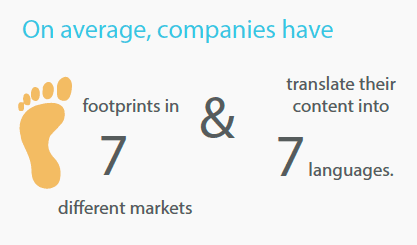
Footprints in different markets


  • In the next 12 months, these companies plan to expand into 7 new markets on average. Ambitious companies are planning to double the size of their international market base, of which 88% require translation services for their new markets. Such a feat will require smart ways to streamline the process, including the use of technology to automate content workflows, centralize translation projects, and provide data to optimize the go-to-market strategy for translated content.
  • The top benefit of content localization: Increased sales in target markets. Translated content doesn’t just look better to international audiences. Companies actually see clear ROI from their content localization efforts, directly impacting their bottom line. Customers appreciate the time companies take to speak in their native language. As the mantra goes, people will do business with those people they know, like, and trust.
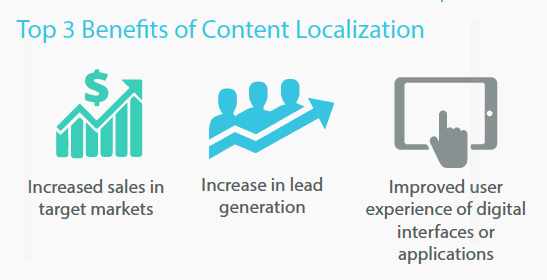
 

Top 3 Benefits of Content Localization


  • Over half of companies find the content localization process to be too manual and needs to be more automated. Emailing spreadsheets back and forth with translators gets complex to manage, especially when scaling up international operations. For those companies that will be in 14 international markets by the end of 2018, keeping tabs of at least 14 translators for 14 different languages will be challenging without the right automation tools in place.
  • The top challenge of content localization: Slow time to market. Recognizing ROI from international markets becomes a challenge when source content just isn’t getting translated in a timely manner. When speed is the name of the game, technology can help to decrease go-to-market time for translated content from 2 days to 10 minutes.
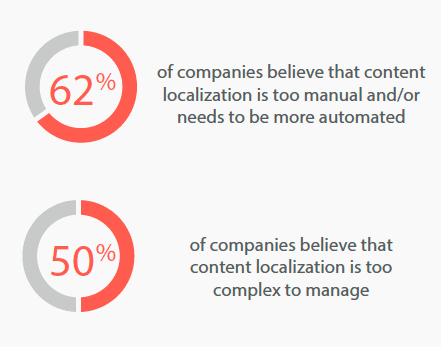
 

62 Percent and 50 Percent


  • 94% of companies plan to increase their localization expenditures. Most companies have expanded the line item in their 2018 budgets for localization efforts to supplement their global expansion efforts. Investments in global marketing are becoming inseparable from investments in localization.
  • A bigger footprint means more opportunities for localization of content services. The top 5 types of content that companies are localizing are their website, social media, digital, video, and technical information. The most successful localization efforts cover these crucial digital marketing channels and the essential steps of the buyer’s journey on the website.


Based on the research results, continued global expansion and increased investment in localization remains a top priority for marketing executives. Most notably, 94% of multinational companies plan to increase their localization spending in 2018 and plan to expand into 7 new markets on average. Companies are moving fast to tap into markets around the world.

At the same time, many of them are looking for ways to improve their localization process and most effectively communicate their brand to new markets.

Juliana Pereira, Vice President of Marketing at Smartling, explains this hurdle that even the most successful brands encounter:

“Companies active in multiple geographic markets understand the many benefits localized content can deliver, but not all know how to best leverage this powerful competitive differentiator. In today’s global business environment it’s all about enhancing, tailoring and personalizing customer experiences. Providing translation in the local language goes the extra mile to show your customers that your brand speaks their language, quite literally.”

As global companies expand their international footprints, there is broad consensus on the immense value of localization to achieving their global market share, as proven by their localization ROI. As expected, international audiences respond positively to content that resonates with their language preferences. Companies will want to keep these key localization statistics in mind to polish up their localization strategies to ensure successful growth in the new year.

Download Smartling’s full trends report, Catalyzing Growth and Revenue Opportunities With Content Localization.Want to learn how translation technology can help companies increase the quality of their translations and go to market faster? Smartling provides a translation management solution for companies seeking to accelerate growth from international markets. Get in touch with a Smartling representative to learn more.


source https://www.smartinsights.com/search-engine-optimisation-seo/multilingual-seo/7-trends-marketers-need-know-translation-localization-2018/

12 must-see free marketing resources before Christmas

Take an exclusive look inside our library of actionable strategy guides, templates, and e-learning modules, covering campaign planning, integrated lifecycle marketing, and managing digital transformation

Our Guides, Templates, Quick Wins, E-learning modules and personalized learning plan are of high quality to help businesses plan, manage and optimize their contribution from digital to multichannel marketing. We cover 7 step strategy guides to actionable templates in Google Sheets, Excel, Word, and Powerpoint.

We deliver briefings on the latest trends and research reports to inform your digital transformation plans. Yet, our core focus isn't top-level research and theory, but actionable best practices for digital channels that directly impact leads and sales.

Our most popular resources, which our competitors don't offer, are actionable templates to audit, forecast and define improvements covering every digital marketing technique. These are field-proven to help our members audit their current performance and identify problems and opportunities to improve results.

For 12 days we will give you a free preview of a different resource, covering in-depth strategy and actionable best practices you cannot miss! Come back every day as we’ll be continuously updating this post to show you more and more winning marketing advice.

Our 12 insights include (more to be revealed each day):

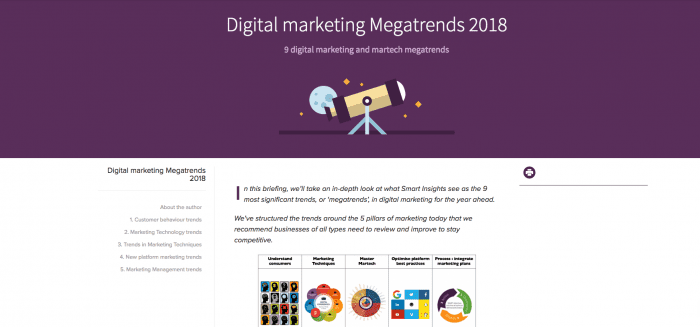
  1. Day 1. 9 digital marketing megatrends 2018


Day 1. 9 Digital marketing Megatrends 2018

We start the 12 days off by answering one of the most sought-after answers this time of the year: “What trends in marketing are likely to have the biggest impact for my business in 2018 and beyond?”

Take a look inside:

9 digital marketing megatrends 2018 preview

Megatrend 1. Skyrocketing smartphone adoption

The growing importance of mobile marketing and apps is shown by these stats (Source: Smart Insights Mobile Marketing Trends statistics compilation)

  • More than 50% of searches are on mobile
  • 91% of Facebook usage (Daily Active users) is on mobile
  • 80% of  Facebook advertising revenue is on mobile
  • 90% of mobile media time is spent in apps

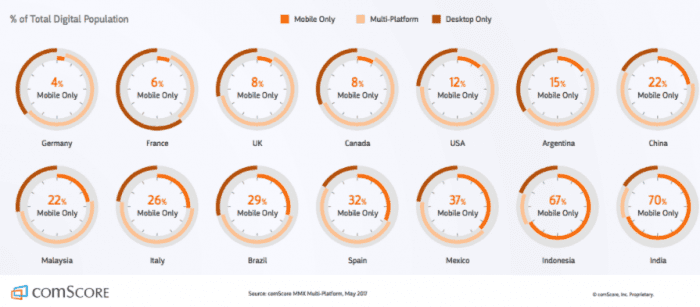
The importance of mobile platforms is shown in this interesting visual from comScore. It suggests that rather than following Google’s ‘Mobile-First’ mantra, most businesses need to develop a multichannel or multiplatform strategy to engage consumers across mobile and desktop

Percentage of mobile users worldwide
Megatrend 2. Increased use of Conversational UIs

Gartner feature Conversational User Interfaces as one of the emerging technologies on their hype cycle which we feature later in this article. We define the scope of Conversational UIs to include:

  • 1. Chatbots. We featured several examples of these in 2017 which run on proprietary platforms. Marketers should also consider integrating with standard platforms for customer service or pre-sales support, for example, Facebook’s Bot Engine for Messenger, which went live in April 2016 when Google also announced its assistant service at Google I/O.
  • 2. Software and human-assisted support. Human-assisted live chat has existed for some time. What is new here is the addition of segmentation and automation rules to trigger messages on site, in-app or through email via technologies like Intercom, Helpcrunch and Drift. These offer not-only service, but can also support sales and audience engagement and are a great fit for smartphone use.
  • 3. Voice controlled search assistants. Voice controlled searches are rising and likely you’ll know about Apple’s Siri, Microsoft’s Cortana, Amazon’s Alexa and Google’s Assistants which can be used on smartphone,
  • 4. Voice controlled connected devices. Adoption has been boosted by advertising from Amazon for its Echo devices and Google’s Home devices launched in October 2017.

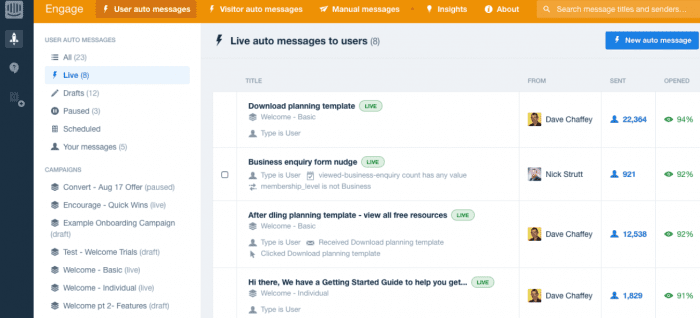
For most businesses, 1 and 2 are going to be of most practical application. It will be interesting to see how Chatbots prove to be, to end users. We’re certainly excited by the potential of Intercom, here is an example from our instance showing rules we have set up to trigger messages in real-time suggesting content to members. These give far higher response rates than email since they don’t suffer from inbox competition and are in the context of a website visit.

Intercom example

Online publisher TechCrunch has noted the trend in Chatbot use, saying that Chatbots have suddenly become the biggest thing in tech, explaining that they promise to:

“Unlock the ability to provide personalised, interactive communication akin to talking to a human customer service or sales rep, but at scale for much cheaper than call centres”

From Facebook’s Mobile Messenger through Facebook’s acquisition of WhatsApp and rebuff by Snapchat to the popularity of apps in non-Western markets like WeChat, there is a continued and growing wish for consumers to communicate directly outside of public social network pages. This is really the last frontier for social media monetization, so we can expect to see some major changes here in 2018 with new options for paid media on messaging apps, although this will be limited since the app owners have committed in the past to keeping messaging ad-free.

So, reaching and influencing consumers as they move from public social media to messaging will remain a challenge to businesses, but as this next trend shows, there will be new options for reaching consumers via messaging.

*We will be updating this article every working day for 12 days with FREE previews of our best resources. If you can't wait for more, by signing up as a FREE basic member, you will get instant access to 25+ resources to start your marketing optimization journey.


source https://www.smartinsights.com/digital-marketing-strategy/12-marketing-insights-christmas/

Free online courses to improve your digital marketing skills

Friday, 1 December 2017

Why social commerce will take off in 2018

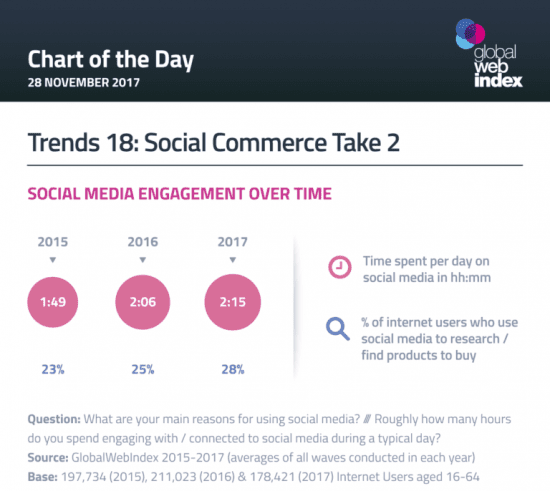
Chart of the day: 28% of internet users use social media to research and find products to buy

Time spent on social media per day is increasing and as a result, online buying is increasing. On average we now spend around 2hours 15minutes per day on social media and 28% of internet users use social media to research and find products to buy.

Our buying patterns are evolving and this is good news for many brands as commerce and social activities are taking place in the same space. Social commerce is taking off and according to Global web index 'as 2017 draws to a close, two converging trends could lay the groundwork for social commerce to re-enter the stage: changing consumer mindsets and evolving social engagement patterns'.


source https://www.smartinsights.com/digital-marketing-strategy/social-commerce-will-take-off-2018/

Why do your customers do what they do? Ask them, not the data!

How Coca-Cola could have foreseen the 'New Coke' crash

It's 1985. For the past 15 years, the Coca-Cola Company has seen market share decline for its flagship product.

After conducting blind taste tests with more than 200,000 consumers, the soft drink brand discovers that consumers prefer a new formula to Pepsi and even to the old Coke. That summer, Coca-Cola rolls out 'New Coke' with an all-star ad campaign.

The product bombs. Badly. Consumers clamor for the classic formula, which Coca-Cola quickly brings back.

How could Coca-Cola, which decidedly did its homework in terms of tasting, fail so spectacularly? The issue is that Coke consumers slurp the soda down for more than taste. Coca-Cola forgot that every time someone pops the top, they're drinking from a well of emotion.

Asking the Right Questions

Since 1985, the power and prevalence of market research has only grown. In 2017, U.S. companies are slated to spend about $16 billion on market research. That figure will roughly double by 2020, but also increasing is marketers’ distrust of their own findings. This year, just a quarter of marketers felt like they were using the right tools and processes — an 8 percent decrease from last year.

Skeptical business leaders often blame the tool or the person administering the tool. But more often than not, the real culprit is a mismatch between the tool and the questions in need of answers.

Coca-Cola used the wrong tool to answer the wrong question. Instead of asking customers which cola tasted better, it needed to pursue the "why" of customers' buying habits. Many participants had grown up with Coke and had an emotional connection with the product and brand. Caught up in taste tests, researchers had neglected to consider customer habits, nostalgia, and loyalty.

Market research is more than a numbers game. As Coca-Cola learned, failing to understand the broad range of customer motivations, triggers, and emotions can lead to a corporate black eye.

Choosing Insight Tools

Digging into the litany of factors that form a customer's "why" requires the right tools. Just as it wouldn't make sense to turn a screw with a chainsaw, marketers need the right tools in hand when collecting customer insights.

Business leaders and marketers often turn first to surveys — or methodological cousins like taste tests, in Coca-Cola's case — due to their ease and affordability. But surveys rarely reveal why customers behave the way they do.

Cold, hard data has its place, of course. But adding more numbers to the mix won't change the fact that two out of three CEOs feel out of touch with their customers. Today's CEOs are struggling to understand the motivators, pains, values, and concerns that underpin their customers' buying decisions.

When it comes to tapping into customers' hearts and minds, the key is qualitative research. Conversations held in focus groups and in-depth interviews equip company leaders with insights ranging from customer pain points to product satisfaction.

What makes conversations so valuable? Think back to New Coke. Are customers buying based on convenience, necessity, nostalgia, or something else? No figure or one-directional response can uncover that.

It Takes Two

When it comes to customer understanding, quantitative tools like surveys and qualitative ones like focus groups both have a role to play. The key is to have conversations first to get a lay of the land.

Had Coca-Cola first held a focus group to understand consumers' relationship with the beverage and their reactions to its potential discontinuation, it could have contextualized the taste test. Learning how much of a role taste plays in the broader purchase decision likely would have led Coca-Cola researchers to assign less weight to consumers' flavor preference for the new formula.

How might Coca-Cola have made the most of surveys? It could have learned when they crave a Coca-Cola, how often customers choose other colas over Coca-Cola due to taste, or how much they'd be willing to pay for a new product. None of those answers are helpful, however, without first understanding why people buy Coke in the first place.

What's more, surveys could have helped Coca-Cola save money. Instead of surveying 200,000 people, it could have surveyed a 10th as many and then extrapolated its findings. Then, it could have followed up with that same group after rolling out New Coke to track the broader market's satisfaction.

As Donald R. Keough, then-president of the Coca-Cola Company, stated after the 1985 New Coke debacle, “We did not understand the deep emotions of so many of our customers for Coca-Cola.” Employing just one research tool was Coca-Cola's mistake. Had it started with customer conversations, it would have realized New Coke wasn't such a sweet idea after all.


source https://www.smartinsights.com/customer-engagement/customer-engagement-analytics/customers-ask-not-data/

How to generate leads on your website with a fun-to-take quiz

Online quizzes are a great way to present your content in a playful way. Quizzes are not only truly engaging, but they also allow you to collect valuable information about your audience

This includes both the insights derived from the quiz answers as well as contact information such as name and email address.

You’ve probably seen them pop-up in your Facebook-feed: “What does your favorite color reveal about your personality?”, “How well do you and your partner fit together?”, “What kind of marketer are you? Take the quiz!”. Quizzes are trending, BuzzSumo called them the “Content Marketing’s secret weapon.”. People like sharing them. Moreover, it is an easy way to repurpose existing content.

But did you know that a quiz is also a true lead-magnet? That is exactly the purpose of this article: explaining how quizzes are used for marketing and how you can start taking advantage of it.

A quiz as a type of interactive content

On WordPress alone, there are 56 million new blog articles published each month. In a world with that much content, it becomes a challenge to grab the attention of your audience. The attention span for written content is low: 55% of your visitors do not stay longer than 15 seconds on your site to read an article.

New types of content such as infographics or video content, allow you to reclaim the attention of your audience. A quiz works in the same way: because of the game-like qualities linked to a quiz, you will grab the attention of you audience faster and keep it longer.

Interaction and personalization

For content marketers, this is an opportunity to include two-way communication in your message. Personalization can be achieved by creating profiles that match with the results of a respondent, or by asking questions that direct your prospect to a specific product.

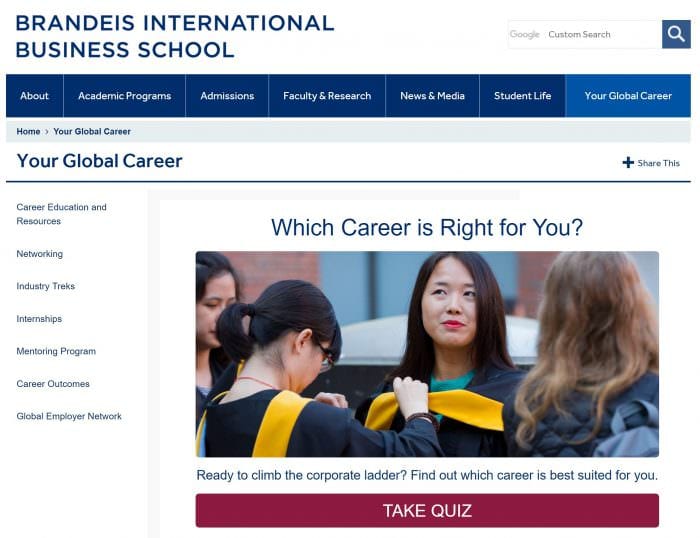
brandeis_quiz_in_website

A good example of personalization is the quiz Brandeis University published to help students with the choice of their career “Which Career is Right for You”. Based on their responses, students get a suggestion for their future career opportunities and they are redirected to the most appropriate educational offerings. By helping respondents with their choice, the university manages to acquire an impressive 125 students per month.

This quiz is a good way to replace a series of landing pages that the student otherwise should navigate through.

Why such a quiz works

Everybody wants to know whether they are a shopaholic or which type of home fits their personality. It can be serious too: which training is most appropriate for you, given your current set of competencies.

We like to hear whether we are good at something, and especially how we compare to others. This self-serving bias is important in a personality quiz, because it helps to put people in certain categories. It gives a positive confirmation about themselves, they have something to recognize themselves in.

A quiz forces you – as content marketer – to split your content into more “bite-size” pieces, which make it less likely for users to quit. It also forces you to make your content more playful and conversational.

Getting insights into the needs of your prospects

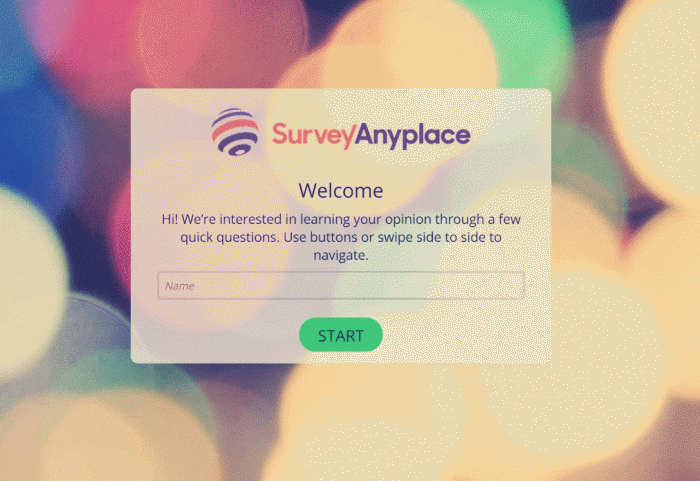
A nice example is the “Find your home-quiz” below, from Module Housing. (FYI: this quiz was shortened as an example for this article – so your email will not be used. You can also look at the gif below)

With this quiz you can, as a potential customer, quickly find out which house is the most appropriate for you. Moreover, the answers are also useful for Module Housing. They can allocate the right sales person based on your type of house. This person already knows your preferences through the quiz and will be better positioned to help you realizing your housing project.

Module housing gif

Unlike a static blog post, you cannot quickly scroll through a quiz and read the summary at the end. You ensure that people are guided in a ‘soft’ way through the complete process, with a reward at the end: they learn something about themselves. The result? People want to take such a quiz until the end

Hot leads

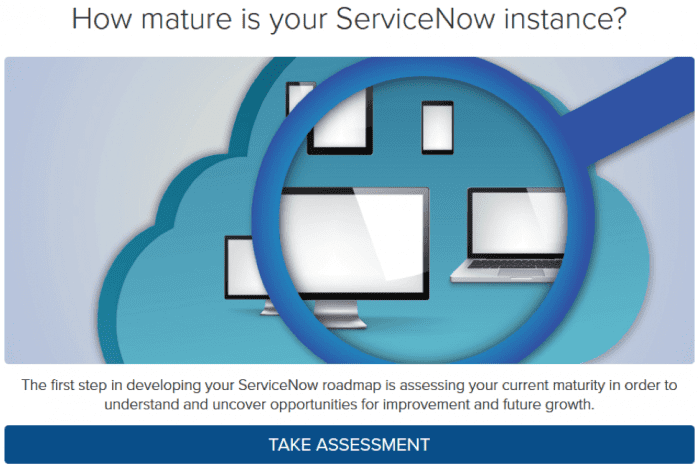
In the same way, Cloud Sherpas collects 4 new hot leads per day through a quiz on their homepage. Hot leads are highly-qualified leads, with an increased conversion probability. These leads indicate that they have an interest in the product by participating in the quiz. Because the quiz is about a niche subject (“How familiar are you with ServiceNow?”), Cloud Sherpas can categorize the respondents and their needs based on their knowledge about the services.

cloudsherpas_quiz

So quizzes are not only a type of interactive content, they also give you the opportunity to get better insights about the different segments in your audience.

How to collect leads with a quiz?

With the current technology and tools, there is no excuse for boring quizzes or questionnaires! In almost all quiz tools, there are useful features to make your life easier. Moreover, these tools are affordable and do not require technical knowledge to set up a great-looking quiz.

Below are a few tips you can apply to start collecting leads using quizzes.

1. Give the necessary attention to design

Ensure your design is attractive, without taking away the attention of your quiz. No problem if you are not a designer: most of the online tools offer great-looking templates that you can adapt with your logo and colors.

2. Include multimedia

If you add pictures, gifs or even an explainer video, the experience is better and it becomes more likely that people will take the quiz all the way to the end.

3. Have a conversation

Keep it short and write in a conversational tone by using short sentences and words like ‘you’ and ‘we’. A quiz or assessment can be considered as a conversation, rather than an article where there is only one-way communication.

If you have a longer quiz, do not hesitate to include some encouraging words when the respondent is halfway, for example: “Great job! You are half way – you will get your results in 55 seconds: that’s how long it takes to get from here to the end in average 😉

4. Keep the attention with different question types

By combining different question types, such as multiple-choice, picture choice or even emoji questions, you keep the attention. The respondent will be less likely to quickly click through the quiz because there is something new every time.

Those were the basics, use following tips to go one step further

5. Use advanced features and take personalization to a next level

Using functionalities such as piping or skip logic, you can guide respondents through their own path in the quiz. It feels like the quiz reacts on your answers and gives a highly personalized experience.

Piping allows using the answers a person gave in subsequent questions or screens. Below GIF shows how it works:

Interactivity example (piping-feature)

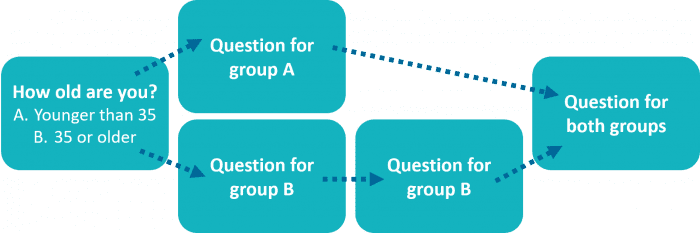
Skip logic ensures that the respondent only gets relevant questions. Depending on the answer that you give, you are directed to different questions. Making the quiz both shorter, more efficient and more personalized.

survey question type - skip logic explained

6. Give something (and it doesn’t have to cost you anything!)

Your reader will perceive your content as more valuable if you give something back. A gift does not need to have monetary value. What works as well: a coupon with a discount, specific information (a comparison of the respondent’s result with a benchmark works very well) or access to specific extra content.

Take a moment to look back at the example of Module Housing. At the end of the quiz, you find out which home suits you best. But in addition, the potential customers receive a full package of additional information and insights via email. All without having to have a face-to-face conversation with a sales representative. Perfect!

If you make it clear for the reader that they will get valuable insights, they will be more willing to provide responses and contact information. You can communicate at the beginning of the quiz that these insights will be relevant for the respondent, even when they decide not to buy your product.

7. Think about how you will ask for the e-mail

It can be as simple as adding a text box to fill in your e-mail. You will increase the number of emails you collect if you consider to:

  • Ask the email at the end of the quiz, just before revealing the score
  • Communicate that you will use the e-mail to send them valuable insights – this can even be a personalized PDF report
  • Clearly indicate that you will not spam and that they can unsubscribe at any time

You have the choice to use the e-mail only to send the results of the quiz, or to use it for subsequent communication (e.g. newsletter) as well. The latter requires a specific opt-in checkbox.

Get started now!

With a quiz, you will make your blog or homepage more attractive, your content becomes more interactive and you will have an additional way to generate new leads! So, there is no better moment to get started than now!


source https://www.smartinsights.com/digital-marketing-strategy/generate-leads-using-quizzes/

Snapchat Statistics 2017

How to use Snapchat marketing in 2018 as part of your social media strategy

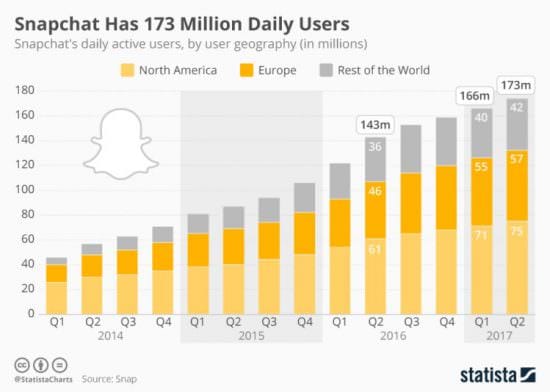
Its been a slow year for Snapchat. Snapchat’s has a total of 173 million daily actives for its entire app whilst Instagram has a total of 700 million monthly users, the Instagram stories feature a direct rival to Snapchat. Instagram has continued to mimic Snapchats old features and Snapchat has had to create new unique features to give users a reason to use their platform.

This year we have seen Snapchat launch new editing tools and camera features, as well as Snapmap and Snap Publisher. Snapchat began in 2011 as a disappearing photo-sharing platform. The app saw significant growth when it first launched but is now struggling to compete with its rival, Instagram Stories. Snapchat made its mark for showing a more authentic and unpolished side of social media. According to SproutSocial, that original feeling is what keeps some of its users engaged to this day.

As we step into 2018 we cover all the key stats from this years to help inform your 2018 Snapchat marketing strategy.

Snapchat statistics 2017

  1. There are 3 billion Snapchats sent daily (Statista ,2017)
  2. Snapchat daily users worldwide – 173 million (Statista,2017)
  3. Snapchats U.S. Daily active users has hit 68 million (Snap Inc. S-1 filing, 2017)
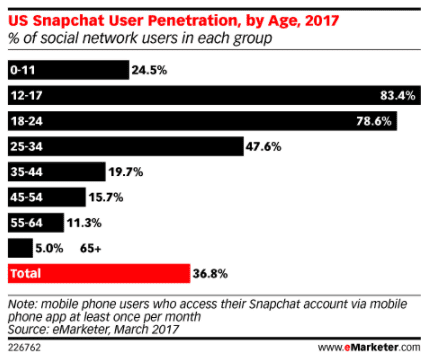
  4. Their key demographic are 12-17-year-olds, it has been reported that Millennials account for 7 out of every 10 Snapchatters. Making it the third most used platform among millennials (Smart Insights, 2017) 
  5. Snapchats Europe Daily active users has hit 52 million (Snap Inc. S-1 filing, 2017)
  6. 25% of Snapchat DAUs post to their Story every day (Source: TechCrunch)
  7. Snapchat has over 166 million daily active users, but its YoY growth rate has begun to slip, falling to 36 percent year-over-year from 48 percent in Q4. (Smart Insights, 2017)
  8. Currently, 60% of Snapchat users are under 25 (Smart Insights, 2017)
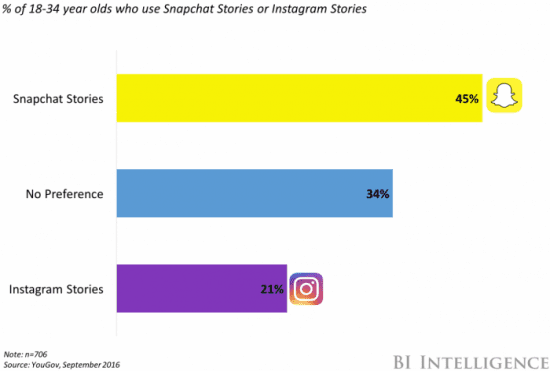
  9. 45% of 18-34-year-olds prefer “Snapchat Stories”, only 21% “Instagram Stories” and 34% of respondents had no preference and are OK with using either of the two 
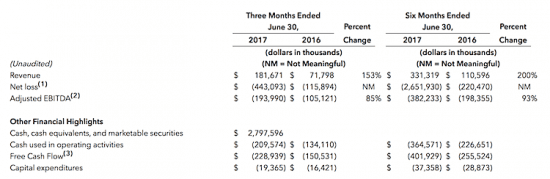
  10. According to the Snap Inc. S-1 filing, in Q2 2017 company made net revenue $182 million, more than twice from $72 million in Q2 2016 

What does this mean for marketers?

One of Snapchat's biggest advantages is its appeal to younger audiences. Millennials were among the early Snapchat adopters, and are still loyal users. Currently, 60% of Snapchat users are under 25. Therefore if your business is made up of mostly millennials, Snapchat may be the better platform for you.

As more marketers turn to Instagram stories there is less competition on Snapchat. So if you are currently seeing ROI on Snapchat continue to push this platform. The key to success on Snapchat is authentic content that offers something users cannot find on any other platform. Share exculsive content

Why not use these six tactics and examples of brands using stories to help inform your own Snapchat marketing strategy.


source https://www.smartinsights.com/social-media-marketing/social-media-strategy/snapchat-statistics-2017/