Wednesday, 21 December 2016

Definitions of Digital marketing vs Internet marketing vs Online marketing

What is the difference and does it matter?!

Before Digital marketing became the de-facto term, I've been asked this question a lot across the years... does the difference in scope between these terms matter? So, as we enter 2017, I thought it's time for another quick look. Here is the latest comparison from Google Trends between 2004 to end 2016.

You can explore the trends on this embed from Google.

Does the difference in these terms and their definitions matter? No, of course not, it's semantics! But it is interesting to see how the scope of Internet marketing vs Digital marketing has changed over time. In my books, when discussing alternative definitions, I explain that, no it doesn't really matter, but the scope and responsibility is important to make the most of managing the opportunities. So the scope of digital marketing activities should be agreed within a business and/or between a company and its agencies. The biggest difference is whether digital marketing is simply seen as about communications (online marketing) or whether it is broader, looking at underpinning marketing technology and options for new online business and revenue models.

The books I've written have actually had three different titles, updated to move with the times. My first text book was titled: Internet Marketing: Strategy, Implementation and Practice. I then created E-business E-commerce Management and, with PR Smith, E-marketing Excellence, for professionals a couple of years later. Then, much later, the names switched and in 2012 we renamed the Internet Marketing book to Digital Marketing with the others becoming Digital Business and Digital Marketing Excellence.  About time too, since I was involved in developing the syllabus as an examiner for the first IDM Diploma in Digital Marketing back in 2004-5 when the term was hardly used at all - so it's been great to see 'Digital Marketing' adopted as the 'de facto' term, when I was first involved in defining it with the IDM students in 2004!

Marketing vs Digital marketing

Today, perhaps the bigger question is whether digital marketing is a necessary term concept since some commentators have stated that we're now in a post-digital era with 'almost all' marketing now being digital now digital media and technology have become so pervasive. My view on this, explained in the post above is that we do very much need digital marketing, since many businesses still undergoing digital transformation and recruiting the digital marketing jobs and roles needed to compete. The trend in search volume also suggests there are more people searching for digital marketing than ever before, albeit with a drop before Christmas.

You could also say that what's more useful is to know within the many different aspects of digital marketing, what is important for getting results today. I agree. See these trends in marketing for 2017 for more.

When we wrote the original Internet marketing: Strategy, Implementation and Practice book in 2000 I used a simple definition of Internet marketing. Internet marketing is...

“Achieving marketing objectives through applying digital technologies.”

I used this succinct definition to helps remind us that it is the results delivered by technology that should determine investment in Internet marketing, not the adoption of the technology!

To help make sure that digital marketing is aligned with growing a business we've developed the RACE marketing strategy framework on Smart Insights which shows how to achieve growth through e-marketing in these 5 areas:

These digital technologies include Internet media such as desktop and mobile web sites and e-mail as well as other digital media such as wireless or mobile and media for delivering digital Television such as cable and satellite.

In practice, Internet marketing will include the use of a company web site in conjunction with online promotional techniques described in Chapter 8 of the book such as search engine marketing, interactive advertising, e-mail marketing and partnership arrangements (affiliate marketing) with other web sites. Some businesses who "want to be top in Google", simply consider Internet marketing to simply equate to Search Engine Marketing, but while this is important this scope is too narrow to take full advantage of digital media.

I identify 6 main types of digital media communications channels which every business should consider as part of digital marketing:

These can be facilitated through the desktop or mobile web. We have more details on the strategy in our visual emarketing strategy guide.

These techniques are used to support objectives of acquiring new customers and providing services to existing customers that help develop the customer relationship.

Definitions of Digital Marketing vs Internet marketing vs Online marketing

However, for Internet marketing to be successful there is still a necessity for integration of these techniques with traditional media such as print, TV and direct mail. This is multi-channel Emarketing.

E-marketing definition

E-marketing can be considered to be equivalent to Internet marketing and Digital Marketing. Most in the industry would look at it this way.

However, Emarketing is sometimes considered to have a broader scope than Internet marketing since it refers to digital media such as web, e-mail and wireless media, but also includes management of digital customer data and electronic customer relationship management systems (E-CRM systems).

Digital marketing definition

Digital marketing is yet another term similar to Emarketing. It's a term increasingly used by specialist digital marketing agencies and the new media trade publications. The Institute of Direct Marketing has also adopted the term to refer to its specialist professional qualifications.

To help explain the scope and approaches used for digital marketing working with the IDM in 2005 I developed a more (too?) detailed definition than the simple one at the start of this post to better scope it and show how digital marketing needs to be closely aligned to broader marketing objectives and activities and involves much more than SEO and inbound marketing. So this is the original definition from 2005 - how should it change now?

"Digital marketing involves:

Applying these technologies which form online channels to market, that's Web, e-mail, databases, plus mobile/wireless & digital TV)

To achieve these objectives:

Support marketing activities aimed at achieving
profitable acquisition and retention of customers… within a multi-channel buying process and customer lifecycle

Through using these marketing tactics:

Recognising the strategic importance of digital technologies and
developing a planned approach to reach and migrate customers to online services through e-communications and traditional communications. Retention is achieved through improving our customer knowledge (of their profiles,behaviour, value and loyalty drivers), then delivering integrated, targeted communications and online services that match their individual needs".

The first part of the definition illustrates the range of access platforms and communications tools that form the online channels which e-marketers use to build and develop relationships with customers. The access platforms or hardware include PCs, mobile phones and interactive digital TV (IPTV) and these deliver content and enable interaction through different online communication tools such as organisation web sites, portals, search engines, blogs , e-mail, instant messaging and text messaging. Some also include traditional voice telephone as part of digital marketing.

The second part of the description shows that it should not be the technology that drives digital marketing, but the business returns from gaining new customers and maintaining relationships with existing customers.

It also emphasises how digital marketing does not occur in isolation, but is most effective when it is integrated with other communications channels such as phone, direct mail or face-to-face. As we have said, the role of the Internet in supporting multi-channel marketing is another recurring theme in this book and chapters 5 and 6 in particular explain its role in supporting different customer communications channels and distribution channels.

Online channels should also be used to support the whole buying process from pre-sale to sale to post-sale and further development of customer relationships.

Multi-channel marketing

Customer communications and product distribution are supported by a combination of digital and traditional channels at different points in the buying cycle

The final part of the description summarises approaches to customer-centric emarketing. It shows how success online requires a planned approach to migrate existing customers to online channels and acquire new customers by selecting the appropriate mix of e-communications and traditional communications. Retention of online customers needs to be based on developing customer insight by researching their characteristics, behaviour, what they value, what keeps them loyal and then delivering tailored, relevant web and e-mail communications.

Customer insight definition

Knowledge about customers needs, characteristics, preferences and behaviours based on analysis of qualitative and quantitative data. Specific insights can be used to inform marketing tactics directed at groups of customers with shared characteristics


source http://www.smartinsights.com/digital-marketing-strategy/online-marketing-mix/definitions-of-emarketing-vs-internet-vs-digital-marketing/

6 Tips to improve conversion on your website forms

How to boost CRO for non-ecommerce sites

When you think of Conversion Rate Optimisation and AB testing, what comes to mind first is probably ecommerce websites, product pages, baskets and checkouts.

But the scope of optimisation programs is much wider than this. We work with several brands, from car dealership groups to home improvement to charities, where the objective is to create a lead, usually via a form – the sale or activity happens in a branch, over the phone or in a customer’s home, rather than on the website.

The challenges when optimising these lead generation sites can be quite different to e-commerce. Here are some of the things we’ve learned over the years.

1. There is no such thing as ‘best practice’ in a lead generation websites

Arguably, there’s no such thing as best practice on any website, but, still, there are some conventions and expectations around checkouts and product pages that can give you a head start in optimising e-commerce sites. No such luck in lead generation – you really are designing for a specific business model and specific audiences with specific needs, and specific barriers to conversion. There is no best practice – you need to find the right conventions for your specific case.

2. You need to think about full journeys, not just websites

E-commerce websites tend to have relatively simple customer journeys – visitors tend to arrive from search, may consider multiple products, purchase, and then receive their product through the post a day or two later.

lifecycle-marketing-model

Lead generation sites play a different role in a customer’s purchase journey, higher up in the sales funnel. Users are still exploring possibilities, thinking about options. They won’t make their decision to purchase or act until something else has happened in the real world, days or even weeks after their visit to the website.

It’s crucial to understand the part the website plays in the wider customer journey, and the part it will play in ultimately converting a prospect to a customer. You need to understand website objective and wider business objectives. Spending time with stakeholders to understand this is critical, and building clear website KPIs is critical.

3. You need to get to know your customers, not just your users

Equally importantly, you really need to understand your users as potential customers – what content and information do they need from the website before they will be willing to take the next step in their journey?

So it’s important to understand what drives their overall purchase (and what might block it), as well as their relationship with the brand and sector. We do this through user research methods like interviews, surveys and ethnographic research, as well as user testing in the lab. We use all this research to create personas and customer journey maps.

4. Persuasion levers are different

Because users are at a different stage of their customer journey on lead generation sites, the persuasion levers you need to pull tend to be different.

On e-commerce sites, persuasion is quite mechanical: visitors need to trust that their purchase will arrive and that their credit card details won’t be stolen; and they need to be nudged into converting before they get distracted and go elsewhere.

On lead generation sites, however, you will need to tap into emotional triggers and blockers. User trust is built primarily at a brand experiential level. Conversion triggers in the interface should be spread differently through the user journey – pushing users to conversion points too early can sometimes confuse them and cause them to drop out in a way that you’re less likely to see in e-commerce.

5. Getting insights from Analytics can be more difficult

Building a funnel (i.e. reporting how users move through the stages of your website and where they drop out) is usually relatively simple in ecommerce sites, because the user journeys are simple – landing page to product to basket to checkout, for example. But in lead generation sites, particularly those with multiple forms of contact, can be more of a challenge. User journeys tend to be less direct and predictable, and users are more likely to make multiple return visits before converting.

This means it’s very important to track the right micro-actions in your web analytics, and that you understand and segment your visitors in the right way. Unlike some simple e-commerce sites, with lead generation sites you really need a highly skilled Analytics expert to set up tracking properly and then mine the data for insights. There’s no short cut.

6. Make sure you understand the value of your optimisation activities

Finally, the big one: if you can’t show the value of your CRO activities, then you won’t get buy-in from senior stakeholders, and you risk them losing interest (and cutting investment) in the whole programme.

With an e-commerce site, return on investment (ROI) is relatively easy to calculate, because you can actually see the extra sales your AB tests are creating. But for lead generation sites, it’s often more difficult to see how on-site changes translate into commercial gain.

Some businesses have all of this joined up in their CRM and reporting systems, with a single customer view across online and offline actions. But not all business have this level of data sophistication, it’s not uncommon at all for businesses to have no clear visibility of how their website connects up to ultimate sales.

And sometimes tracking a customer just isn’t possible. For example, there’s no way to track a website visitor who closes their laptop and drives to a real world outlet (showroom, car dealership, etc) – but the website has clearly played a part in that sale, and should be credited.

It’s important in these cases to agree an attribution model up front with your stakeholders. Even when a single customer view doesn’t exist, you can usually agree a commercial value on website actions, based on known metrics (prospect-to-sale conversion rate, for example) and through running surveys and other user research to quantify and benchmark different offline journeys.

In some ways, optimising a lead generation website is the same as any other site – you look for opportunities in the data, research your users, and run A/B tests. But the way you do this on lead generation sites is more subtle, and more complex. Hopefully these tips will help set you on the way to making a success of your lead generation CRO programme.


source http://www.smartinsights.com/conversion-optimisation/conversion-optimisation-strategy/6-tips-improve-conversion-website-forms/

Tuesday, 20 December 2016

Key Financial Industry Trends

Chart of the Day: Key Financial Services Industry Marketing Trends

There were 347 million mobile payments made via banking apps in 2015. This is a rise of 54% compared with 2014. In addition to 417 million payments made via internet banking in 2015, a modest 2% rise from 2014.

The chart comes from a report by BBA, which is the UK's largest trade association for the banking sector. The report found:

  • With 40,00 financial app downloads a day in 2015, this is a 25% increase on 2015. The question for the beginning of 2017 is, what will 2016 show?
  • There were also 4.3 million mobile banking logins in 2015 and 11 million app logins a day.
  • There were 15 million Contactless cards issued in 2015 and 250% annual rise in spending using Contactless cards.
  • There were just 71 bank branch visits a day in 2015.

Source: BBA 

Find out more about the latest financial services trends in our business level Financial Services Marketing Trends guide.


source http://www.smartinsights.com/digital-marketing-strategy/key-financial-industry-trends/

How Small Business can Leverage Marketing Automation

SMEs needn't be left behind by new Marketing Automation tech

A dismal 37 percent of shoppers say that the average retailer “gets” them. It’s perhaps for this reason that consumers spend a lot of time researching online before making a purchasing decision offline. And for the first time ever, - as data shows - there are more online sales than in brick and mortar stores in some sectors.

The difference is that the new kids on the block - the ecommerce guys - are making use of technology to improve the customer journey, which is one of the most critical factors to keeping customers and attracting more business.

In fact, C-suite executives reckon four particular technologies will be key for marketing success in the future:

  1. Cloud computing and services
  2. Mobile solutions
  3. The Internet of Things
  4. Cognitive tools

This article examines the top marketing trends for 2016 that are specifically related to these four technologies, and how you can use them to enhance the customer experience in your small business.

1: Cloud computing and services - marketing automation

The digital marketing process involves a plethora of time-consuming tasks. Marketing automation is a cloud-based service that dramatically cuts down the time that business owners need to spend on routine tasks. Marketing automation ensures precision and optimization of business resources as well as the customer experience.

best-digital-marketing-techniques-2016

Grey indicates trends for 2014 - 2015 and dark purple shows trends for 2016. According to Smart Insights, marketing automation is the top digital marketing priority in 2016, followed by content marketing and big data.

The Big Boys - are using tools like Salesforce and Marketo, but even startups can get in on the action with more affordable marketing automation tools like ConstantContact and GetResponse, both of which were specifically developed with the small businesses owner in mind. get-response

Image source: GetResponse

Dramatically improve the customer experience with the GetResponse drag and drop workflow planner.

For instance, depending on the platform you choose, small businesses can:

  • Easily create email marketing workflows that enhance the customer journey.
  • Host informational webinars.
  • Build professional, high converting landing pages.
  • Conduct surveys about their target audience’s needs and expectations.
  • Integrate shopping cart abandonment processes into email workflows.
  • Analyze data to make improvements.
  • Utilize advanced email marketing features, like scoring, tagging and segmenting.

However, there is another trend entrepreneurs should be aware of, and that is that many small businesses select the wrong tool, and end up utilizing only a quarter of the capabilities. For example, ConstantContact provides a unique platform for nonprofits or companies that hold lots of events, while GetResponse is good for online marketing.

2: Mobile solutions - customer support

63% Of people use mobile devices a few times each month to find customer and product support. When they do, what does their journey look like with your business?

In other words, have you made it easy for them to get help from you when they use their mobile device to do so?

mobuile-customer-support-issuesImage Credit: SoftwareAdvice

The most common issues when trying to find customer support via mobile devices are:

  • Difficulty navigating websites.
  • Searching results are not helpful.
  • Time to load is slow.
  • The website is not searchable.

If you provide a service or product online, you’ll need to make it easy for customers to get support when using mobile devices.

One option is using a tool like Zendesk’s Mobile Help Center application which makes all your resource documents easy to access from mobile phones:

zendesk

3: The Internet of Things - combining offline & online

The Internet of Things (IoT) means connecting online and offline through the Internet. It’s not common with small businesses, which is why if you can leverage it, your business will have a tremendous edge over your competitors.

What can your business connect and synchronize, to impact the customer experience journey?

internet-of-things

Image Credit: KESolutions.Biz

An example is the Point Defiance Zoo & Aquarium in Tacoma, who's online ticket sales have increased by 700% since implementing analytics technology to combine offline and online marketing activities. The zoo will move to mobile ticketing sometime in the future, so that visitors can use their mobile devices to "check in" at specific exhibits, dramatically improving the customer experience.

Smaller retail companies can install sensors that monitor foot traffic and customer behavior in-store. When this is combined with sales data, powerful findings emerge that have the ability to influence the customer experience.

To utilize IoT, small businesses need to consider existing problems or ideas and then ask an IoT expert to provide solutions.

For instance, a lawyer was standing in the airport, waiting for the carousel to deliver his bag, when he had a lightbulb moment and thought, “why can’t the airport notify me by Bluetooth when my bag’s about to be delivered?” Bingo. That right there, is IoT thinking in action.

How can your business combine sensors with the offline world, to improve things for your customers, or even create new products or service offerings?

4: Cognitive tools - using user behavior for better customer experiences

Cognitive computing mimics the way the human brain works. It’s a smart machine; a computer that thinks like a human. The tools that emanate from cognitive computing, turn data into powerful insights.

Small businesses can use cognitive tools, analytics and predictions, to access data that their customers create every day, in order to understand and learn from it, with the end result to drive loyalty and build trust, giving customers the right experience at the right time.

confused-customer-journey

Image Credit: GeoffLivingston

For instance, when a shopper abandons their online cart, does the store understand why? Do they have processes in place that will ease the consumer back to the store, to complete the shopping process?

A practical example is the ecommerce store that uses GetResponse Marketing Automation to track and analyze user behavior on the website and then creates an email workflow with conditions, filters and triggers to re-initiate relations via email (learn about using best practices for cart abandonment emails).

But even more striking is when businesses use cognitive tools to tap into the emotions of their customers, to deliver an experience at precisely the right time. IBM suggests businesses start with a cognitive strategy to answer these questions:

  • Who are you focused on?
  • What action do you want them to take?
  • How do they want to interact?

In summary, small businesses can create applications that think, based on their customer's needs...imagine the power.

Key points

Customer experience is the focus in marketing trends for 2016, and undoubtedly, in the next few years.

The four technologies that will be key for marketing are cloud computing and services, mobile solutions, IoT and cognitive tools.

Small businesses can also utilize these trends, by:

  • Using a marketing automation tool
  • Mobile help desk solutions.
  • Brainstorming ways to combine offline sensors with the online world for a better customer experience.
  • Using or creating cognitive tools based on user behaviour, to deliver a user experience at the perfect time.


source http://www.smartinsights.com/lead-generation/marketing-automation/small-business-can-leverage-marketing-automation/

The key trends which will shape financial services marketing in 2017

Big trends in tech and digital are set to change how financial services firms market themselves in 2017.

In many countries, the financial sector is facing significant challenges as new online services are created. In some, such as the UK, the government is actively seeking to encourage new entrants such as the new wave of challenger banks Atom and Modem and the incumbents are seeking to upgrade their legacy systems in order to meet the ever increasing expectations of digital savvy customers.

In this blog, we explore key trends, latest developments and digital innovations and how they apply to both business and consumer markets ranging from established financial services brands and new fin-tech startups to IFA intermediary market.

AdWords changes affecting financial services

Google AdWords and display advertising, often referred to as Paid Search Marketing or PPC, is not new territory for most financial institutions and still occupies an area of critical importance to new customer acquisition in the FS sector. This graphic shows how financial keywords change throughout the year, and it may be wise to adjust your bids and campaigns accordingly.

Some key trends for financial services brands using AdWords are; Google's new re-design, the increasing importance of quality scores, the growing importance of negative keywords, and increased AdWords spend driving up bids. For more information on these trends, expert business members can view our full guide to financial services marketing trends.

Apps and great mobile UX becomes crucial for financial services

Financial transactions via smartphone apps witnessed explosive growth, showing a major trend in how customers manage their finances. Data shows that UK customers have downloaded banking apps on 22.9 million occasions by end of March 2016, a rise of 8.2 million in just one year (Source BBA) as mobile banking overtakes branches and desktop as the most popular way to bank. This trend is not confined to just banking, mobile apps are now being used to renew policies for insurers, serve interactions between the company and intermediaries/suppliers in the insurance sector and apple pay is transforming the mobile payments at the point of sale.

New technology is starting to make a major impact on the functionality of mobile app for financial services. New features such as biometric logins, mobile alerts and AI in mobile apps are all starting to be used by the most innovative companies in the marketplace. For more information on utilising these new tech trends, Expert business members can access our new financial services trends guide.

UX and CRO

Perhaps the most major change within digital FS is its approach to UX and product design. The Financial Services Industry has traditionally created UX and design experiences from an experts point of view but this has significantly changed with a greater understanding of UX being about the digital customer combined with a data-driven process of customer insight. As a consequence banks, insurance companies and financial institutions are now building strong in-house design capability which are shaping new product design and development. Examples of this change include Direct Line, Nationwide and Old Mutual who have both invested heavily in recruited design and UX skills in-house.

UX and design should be included at a strategic level of product development because FS brands lose a valuable opportunity in framing the problem from a customer’s point of view. Make sure you have invested good in-house resource for design and robust user experience research up front.

Other major trends

Other key areas where financial services companies need to be aware of major trends for 2017 include:

  • Emerging Technology, such as Bitcoin, Blockchain and digital share dealing.
  • Changing in Social Media Channels, such as increased use of video and social messaging platforms.
  • CRM trends, such as single customer view, channel integration
  • Digital investment advisors

For a detailed guide to these trends, plus further information on the trends already discussed here, along with case studies of what has worked in various financial services brands, download the full guide to financial services trends for 2017.


source http://www.smartinsights.com/manage-digital-transformation/digital-transformation-strategy/key-trends-will-shape-financial-services-marketing-2017/

Global social media research summary 2016

Our compilation of the latest social media statistics of consumer adoption and usage

Social networks are now so well established, that there are now a core 'top 5' social networks which doesn't change much from year-to-year. But, as we'll see in this post, the most popular social media sites vary a lot by level of usage in different countries and demographics. So understanding these differences in popularity of different social networks is really important when targeting specific audiences. When comparing the most popular social networks it's best to review them by active account usage, not just the number of user accounts. We'll also see in this summary that some social networks are growing more rapidly than others while some are now in decline.

2016 social media stats update

We'll keep this post updated during 2016 as the latest statistics are published drawing on our recommended top 10 digital marketing statistics sources. In this, the 4th update of the year, we'll be pointing to new data around social media channel penetration in the US from Pew Internet, as well as interactions based on research by Trackmaven, but first, we present the answers to some of the key questions marketers should consider when deciding on how to invest their time in social media.

Q1. Which are most popular social networks?

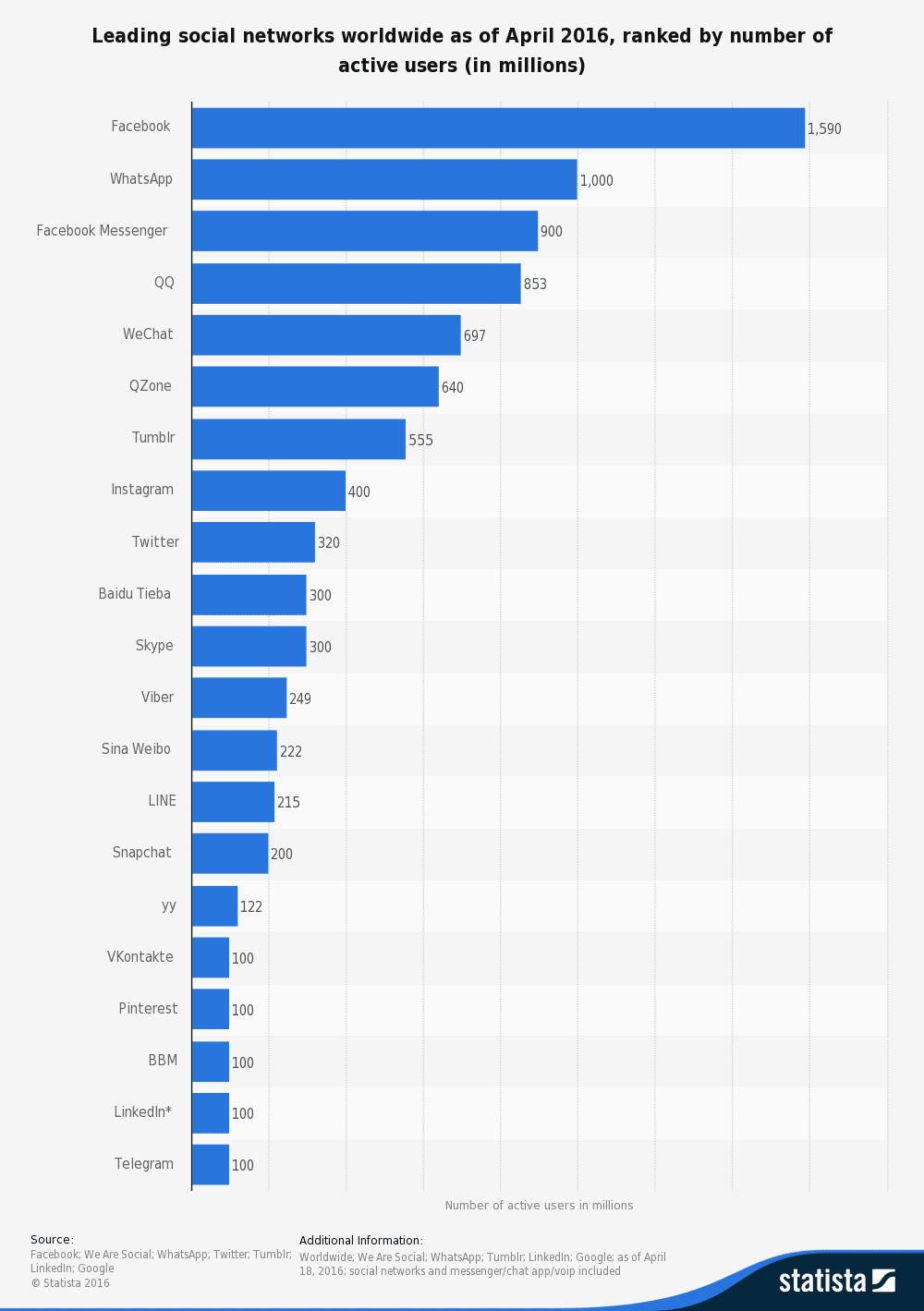
This compilation of the most popular social networks worldwide prepared by Statista gives a  clear picture with Facebook ruling supreme. This won't be a shock to anyone! With over 1,590 million active users, it holds an 18% market share, 7% more so than its closest competitor, the Facebook-owned, WhatsApp.

Most Popular Social Networks Globally

Following from this, we have predominantly APAC favoured platforms, with QQ (9%), WeChat (8%) and Qzone (7%) all with over 600 million active users, highlighting the array of offerings the APAC. We then see a cluster of predominantly western social media networks in Tumblr (6%), Instagram(4%) and Twitter (4%).

Among US users (the most advanced major market and thus a good bellwether for future global trends) Facebook is also retaining a huge lead on the competition. It actually increased it's penetration to 89% of US internet users, whilst Facebook-owned Instagram came 2nd with 32% penetration.


Q2. Which are the fast growing social networks?

Every marketer has limited time for social media marketing, so which social network should you focus your efforts on? This compilation from Statista on the growth of Twitter shows how it compares to Facebook, WhatsApp and China's WeChat  - it's clearly losing ground - sad since we love it!

Twitter growth

Q3. Which is the most engaging social network?

Another factor which determines the time we put into social media marketing is the engagement of the audience. Here we again see the dominance of Facebook - it's also got the greatest engagement in time according to this insight from the US consumer panel from comScore.

social engagement

The above chart from Comscore shows engagement in terms of time spent on the platform vs reach among the millennial demographic. It's interesting to see how effectively Facebook dominates, but also interesting to see how well Snapchat is doing in terms monthly usage per visitor.

Facebook dominates social landscape

Facebook's dominance is truly extraordinary. Not only does it take the top spot, it's other platforms also take 2nd and 3rd respectively. Facebook Messenger has an impressive 47 penetration, and Instagram (also owned by Facebook)  comes 2nd for engagement.

In this recent chart from Pew Internet below, we can see in terms of active daily use Facebook is also in the lead. 76% of users log in daily, whilst 51% do for Instagram (owned by Facebook). Twitter manages just 42% of users login in daily, only just over half the Facebook figure.

Q4. What the different interaction rates in social media

TrackMaven analysed 51 million posts from 40,000 different companies over 130 industries to establish which social networks achieve the greatest engagement per follower. The results show that Instagram absolutely dominates when it comes to interactions per 1,000 followers. In fact, it is so much higher than the other channels we've had to include a second chart just to show the difference between Facebook, LinkedIn and Twitter!

social engagment per 1000 followers

Facebook Twitter LinkedIn Engagement

As you can see, Instagram dominates, but when it comes to the other networks Facebook has a considerable lead on Twitter and LinkedIn. This is in large part because people tend to post a lot more on Twitter because it doesn't have an algorithm that only serves posts to a small section of an audience. This has turned Twitter into a bit of fire hose of content where companies have to share more and more often to be heard through the noise. This has resulted in lower engagement per post.

Q5. What is the overall Social Media usage globally?

We also want to highlight the great summary of social media and mobile stats from WeAreSocial Singapore, which is mainly extracted from GWI who they partner with.

For statistics on the social network usage and growth, we recommend Global Web Index (GWI) as one of the most reliable research sources of social media statistics to compare consumer use and engagement across different social networks. Research is conducted in quarterly waves, each of which has a global sample size of more than 40,000 internet users. Many other social media research programmes are no longer active. Although Global WebIndex is a paid subscription service, their blog provides useful insights on digital consumer behaviour and the Global Web Index Slideshare gives the latest top-level summaries which we share later in this compilation.

Each year, We Are Social update their massive global compendium of stats which gives some great insights into the world of social media. It's a great download for presentations. It's particularly interesting how far some countries are diverging in terms of social media use, and surprising that Western Countries are actually lagging a fair way behind in adoption rates.

we are social

Annual growth continues apace, particularly in the number of mobile social users, which hit 17% last year.

annual growth social global

Asia-Pacific is driving much of this growth, which internet usage rates high and number of active social media users increasing 14% on the year before.

Screen Shot 2016-02-15 at 12.04.37

When looking at the world by number of internet users, it really rams home the importance of East Asian and South Asian markets. Digital offers new opportunities to reach these people, although as always cultural differences are considerable challenges to international marketers.

internet use by region

The full report from we are social contains a massive amount of data across 537 slides. It provides country-specific data for the vast majority of the world, so you might want to check out the slides of the countries in your core markets to get a better idea of the current state of social in the areas you operate.

US Social media adoption

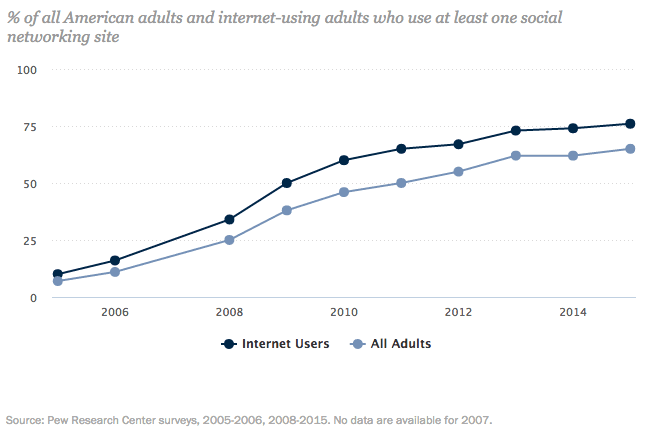
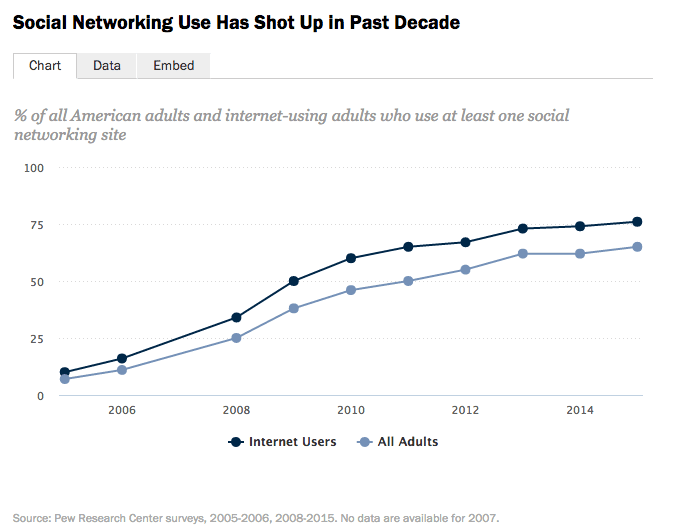
US consumer technology adoption specialists Pew Research Center released a new set of data on US Social Media US on October 8th which shows the latest social media trends and how far it has permeated society. Looking at data from the past 10 years, it charts the meteoric rise of social media.

10 years ago on 7% of the US population used one or more social networking sites. Now that figure has increased almost tenfold, to 65%. Of those who use the internet a massive majority of 76% of American's use social media.

Pew social media trends 2005-2015

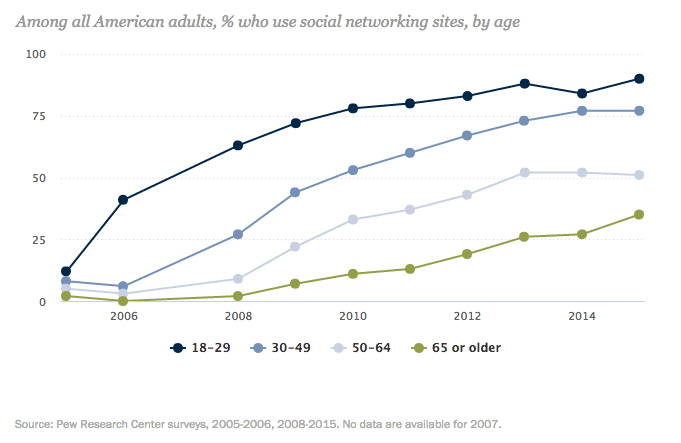
Social Media has grown massively, but it's growth is now starting to plateau. Interestingly the over 65s segment are now driving growth, as other age groups have plateaued completely and use is hardly growing it all. Among the 50-64 age cohort, use hasn't increased since 2013. 
Pew social media trends by age group

Social network popularity by country

This is a great visualisation of the popularity of social networks based on the interviews in the GWI report. If you pick out your country it's probably way behind the countries in which these four core social networks are most popular. Indonesia, Philippines, Mexico, India and Brazil are in the top 10 for each with significantly higher levels of use than the US, UK and European countries.

2015 Social network popularity by country

Use of social networks by different demographics

This chart is striking for the similarity of usage across different age groups. It shows that the social networks are now at a stage of maturity where they give opportunities to reach all age and gender groups. The exceptions to this are Instagram and Tumblr which are clearly popular with younger age groups.

Demographic use of social networks - age and gender


source http://www.smartinsights.com/social-media-marketing/social-media-strategy/new-global-social-media-research/

Monday, 19 December 2016

What type of content is the most effective for B2B marketing?

Chart of the day: Case studies, best practice advice and how to guides are the most effective types of content.

A recent survey of over 600 B2B marketing professionals reveals what types of content they found to be the most effective. The report makes for interesting reading, and as the chart below clearly shows, case studies stand out as the most effective content type for B2B marketers. Best practice advice was extremely close behind, whilst how to guides and market trends were also judged to be effective.

Other types of content were found to be useful by less than a quarter of B2B content marketers. This shows that the 'hard sell' and listing product features is no longer effective, and providing information such as case studies and guides is now the superior tactic.


source http://www.smartinsights.com/b2b-digital-marketing/b2b-content-marketing/type-content-effective-b2b-marketing/