Tuesday, 28 November 2017

How to score SEO points for free with this tool

How to make the most out of SEO tools to increase your internet presence

When it comes to SEO, you can’t have enough hacks or tricks up your sleeve (at least, I can’t). After all, ranking on Page 1 of the Google can take your business from zero to hero pretty quickly. So all of us digital marketers try our very best to achieve the coveted page 1 rank for a high-volume keyword.

There are a ton of tools out there that can help you try and do this. For instance, SEMrush and Ahrefs to determine the best keywords. But since we're all a fan of freebies and creative hacks (aren’t we all?) - I'll share how a simple tool like a good alerts system can help raise your awareness too, and bump up SEO efforts.

SEO alerts

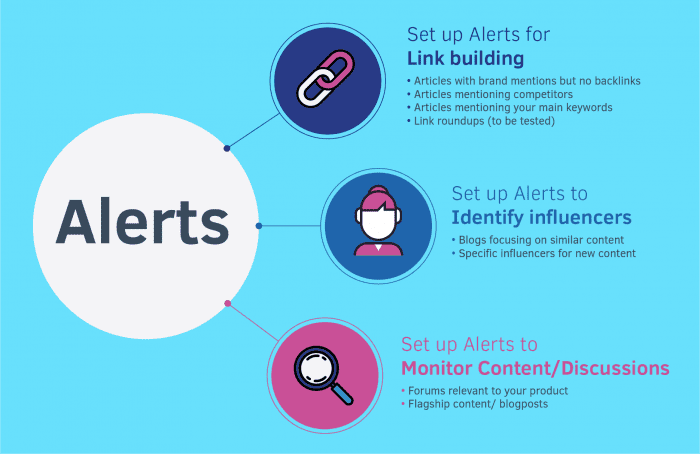
Alerts for Link Building

One of the most powerful factors determining your rank on Google is the number of backlinks you have. The term link equity refers ranking factor based on the idea that certain links pass value and authority from one page to another, improve page, or even domain authority. Even though they’re probably not your favorite things to do - regular outreach and tracking each social mention are the best ways to achieve this. But the immediate question that comes to mind is who would be interested in my post/product? And what tool do you use to answer this? Talkwaker Alerts lets you do this:

  • Alerts help you find versatile opportunities for link building quite easily - for instance if you set up alerts for your brand name or keyword, you’re going to get a list of posts which mention your brand and/or keywords. You’d be surprised at how often people mention you but don’t link to you! After you're done identifying a list of these posts, reach out to the authors and request that they link back to you.
  • More often than not (unless it’s against the website policy), they'll be willing to link to you - probably because it makes for a better user experience for their readers. Talkwalker Alerts makes this even easier because you can choose to receive results only from blogs - so you don’t need to sort them on your own and can just reach out to bloggers. The other thing you can do is set up alerts for your competition - more often than not, an article is enriched if they have multiple options to recommend.

Pro tip: Set up an alert for Link Roundups. They’re always the low hanging fruit of the outreach world. For instance, you can have an alert set up for weekly roundups on social media. You'll know exactly which ones are more likely to link to you if I ask (nicely).


Alerts to Identify Influencers

Influencers = blogs with high domain authority. High domain authority = better quality backlinks and in turn, higher rankings on Google. Sounds straightforward enough, but here again, we have a problem. Which influencers are writing about topics you’re focusing on? Who is likely to give you a backlink? Who writes often and has a bunch of opportunities for backlinks? The answers to all of these questions can be found using an alerts system.

  • Initially, you can set up a query for topics you're interested in and use Talkwalker Alerts to filter down for Blog only results. This helps you identify blogs that are relevant to the industry you work in. You can replicate this with Google Alerts - the only difference is that you would need to manually select the blogs that are interesting to you.
  • Then, you set up alerts for the blogs identified in the previous step to receive updates on the kind of content published by them. The best part is, this enables you to interact with bloggers on Twitter or other social networks and forums. Which means that you can make a tiny space (wave?) for yourself on their radar. And if you’ve tried building relationships with influencers before, you know that the first step for this, in most cases is to engage with them - what better way to do that than discussing their work?

Pro tip: Wherever possible, try to add comments (with links) in the comment section of the blogs you’re tracking. After all, every link counts and gets you noticed. This comes with a heavy disclaimer though - your comments need to be relevant, nothing is a bigger turnoff than spammy comments.


Alerts to Monitor Content/Discussions

As digital marketers, we all know how important it is to inject ourselves into conversations at the right moment, with a strategically placed link (or two!). Alerts help you track and monitor relevant discussions about your brand or keywords - so you can start interacting with the most qualified audiences at just the right point in the conversation. If nothing else, this is sure to drive a bunch of traffic to your page.

The other thing that’s useful to do, if you have a piece of content that’s working very well for you (flagship piece), is to set up alerts for your content so you know whenever your content is mentioned. This is really useful for keeping track of your backlinks and the buzz around your post.

Pro tip: Set up alerts simultaneously for the SEO keyword your content is optimized for and find related backlink opportunities - two birds, one stone!

It’s safe to conclude that although SEO is most definitely a long-term game, there are some hacks and quick fixes that can considerably speed it up. Moreover, though you’ll find a bunch of tools (they’re mostly freemium tools) that help you identify promising keywords and their corresponding metrics - search volumes, competition, etc. - using free tools for the more labor-intensive parts of outreach to help your SEO efforts is pretty satisfying.


source https://www.smartinsights.com/search-engine-optimisation-seo/link-building/score-seo-points-free-tool/

Monday, 27 November 2017

Online revenue models of the biggest digital brands

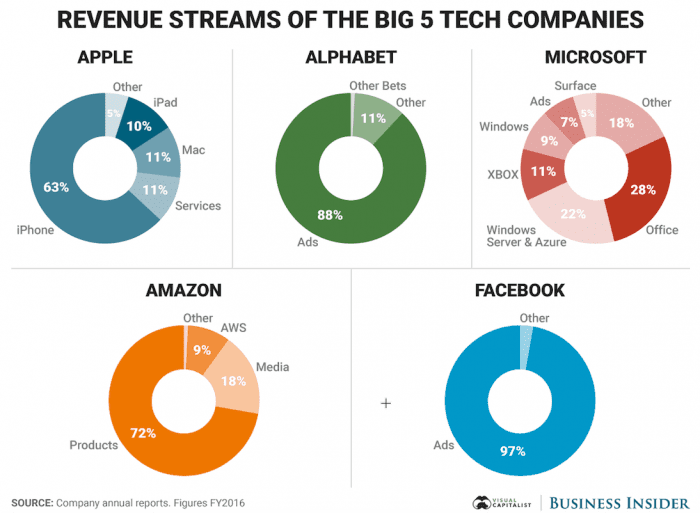
Chart of the Day: How do Amazon, Facebook, Google, Microsoft, and Amazon make their money?

In this article, I defined Eight online revenue models along with how they are calculated, so they could be applied to new revenue models of startups.

In this chart of the day, we can see a comparison of the four / five dominant digital brands sometimes known as GAFA of FAMGA or even the frightful five.

Of these five digital businesses, it's no surprise to see that Alphabet (Google companies including their research and development) and Facebook are dominated by ad sales. Apple sales are dominated by product sales with iPhone much more important that Mac laptops and iPad. Data services like iTunes and storage are still relatively small (11%).

Amazon is different to the other four in that it focuses on online retail, yet this is less than 75% of sales showing its success in diversification to media (18%) and Amazon Web Services (9%). Microsoft has the most diverse revenue from both software, hardware and media. With 22% from Windows Server and Azure, Microsoft is successful in B2B services also.

Research source


source https://www.smartinsights.com/digital-marketing-strategy/online-business-revenue-models/online-revenue-models-of-the-biggest-digital-brands/

Yes, a robot can write your advertizing copy – here’s how

...And you won't be able to tell the difference

2017 is the year that copywriting by Artificial Intelligence (AI) has moved from science fiction fantasy to commercial fact. Game-changing new tools mean that computers can now produce convincing, accurate product descriptions that look as if they were penned by a trained copywriter. The future has arrived.

Many people regard AI as a bit of a joke and cannot imagine a day when software will write better than humans. Tay, the ill-fated Microsoft chatbot, became a laughing stock when she went from innocently playful tweets to racist rants and swear words in just 24 hours.

Who wouldn’t snigger at the romance novel titles generated by a state of the art neural pathway software, including such classics as Surgery Seduction, The Man for Dr. Husband and Lady Convenience Wife?

Yet in 2016 a world first for AI writing occurred at the Rio Olympics. The Washington Post covered 300 events using Heliograf, their in-house AI software. These robot-generated articles were published alongside ones written by humans.

Crucially, no-one spotted the difference. The paper now regularly uses Heliograf for sports reports like the one below and the same software is used under license by news organizations around the world.
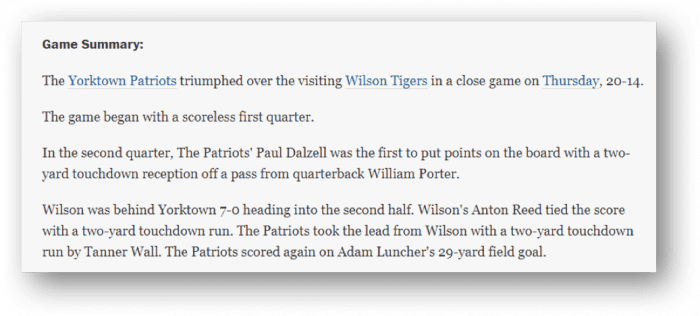
Heliograf

Massive investment in Artificial Intelligence

So why has AI suddenly got so advanced? One reason is a recent explosion in investment that is now starting to bear fruit. Since 2014, AI has been a hot new target for ambitious venture capital funds. Across Europe, fundraising is booming. In 2017 there were 271 funding rounds for AI start-ups raising an average of $3.7m each, according to Serena Capital. That was a 250% increase on the previous year of 83 rounds.
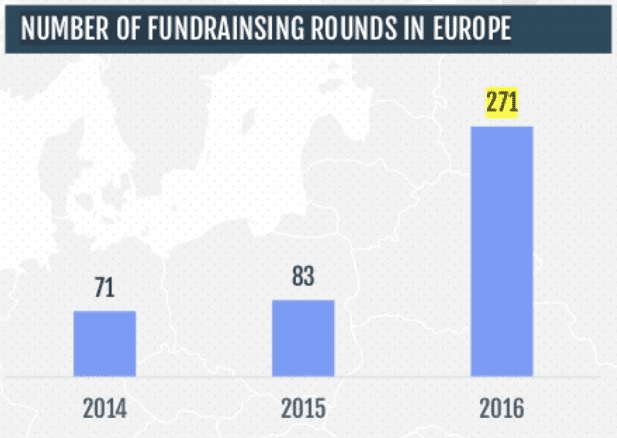
Serena Capital - AI funding 2017

Although these include a broad spectrum of AI specialties, not just those involved with Natural Language Processing (NLP), the trend is clear. It’s little wonder that Gartner predicts that by 2018, 20% of all content will be authored by machines and the International Data Corporation (IDC) estimates that the AI market will grow from $8billion in 2016 to more than $47billion in 2020.

Natural Language Understanding v Natural Language Generation

Any human who tries to learn a new language generally finds it easier to understand than to write or converse. Computers are the same. Natural Language Understanding (NLU) is much easier for them than Natural Language Generation (NLG).

NLU software is brilliant at hunting for keywords or key concepts in documents or the spoken word or rapidly scan thousands of pages and making sense of it all. However, NLU can’t create an article worthy of the Washington Post.

For that you need its much smarter cousin, NLG, the software designed to create original text from scratch that could soon be writing your web copy. Because it’s so difficult there are hundreds of tech firms worldwide working in NLU but only a handful dedicated to NLG.

Beautiful writing by Quill

An acknowledged leader in the field of Natural Language Generation (NLG) is Chicago-based Narrative Science and its platform Quill. Many NLG systems so far have been underpinned by templates, which is why so many sound robotic.

By contrast, Quill is smart enough to understand the user’s intent, pick out what’s interesting and develop an understanding of the story to be told. Feed it some structured data and Quill will transform it into a written narrative with a tone and style that reads as if a living person had sat down and tapped it out on a keyboard.

Customers of Narrative Science are a diverse bunch, including USAA, Mastercard, and the US Intelligence community. The company also works with over forty different partners including Microsoft, Deloitte and Tableau.

Product description copy written by a computer

One of its partners, Indix, has developed a Products Information Platform that marries the writing capabilities of Quill with its own vast catalogue of product data. To date it has collected information on over a billion branded products, plucking details from internet sources such as retail and brand websites and feeds.

Indix then uses AI and machine learning to clean, refine and structure each record into a standardized format. Key details such as category, price, size, availability and other features are all captured, ready to be made into unique, search engine optimized product descriptions. It’s hard to believe that this copy for adhesive (below) was written by a computer:
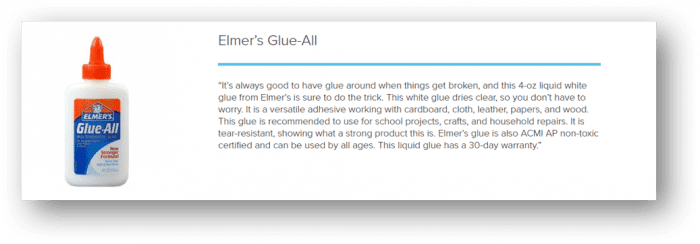
Adhesive AI copy

Say you have a website selling barbecues.  At the moment, you would need to get specifications from a dozen or more different manufacturers. All the sizes, burner and grate specifications, colour options, accessories and other attributes come to you in different formats, often with key features missing.

You then have to rearrange them into a standard order and write some copy in your brand style. Each one has to be checked for accuracy, approved for tone and style and tracked as it makes its way through the system. It’s expensive, laborious and time consuming with lots of potential for error.

That could soon be a thing of the past. Once everything is set up, Indix can create vast numbers of standardized product descriptions in just a few hours, all guaranteed accurate, free of spelling errors, optimized for search engines and at incredibly low cost. If copy needs to be split tested, Indix can swiftly and easily generate two different versions, such as one with bullet points and one without.

Copywriting project management

Over the years, I have headed up teams of writers producing large amounts of product copy. There is striking parallels in the way those projects are managed and the AI process.

Both start with a setup phase, in which a master document is created with all the available information for every product. I give the writers examples of tone and style while Indix builds a phrase library. In both scenarios a tight specification is drawn up defining attributes such as word count, number of bullets, keywords, where the benefits should appear, important features not obvious from the product photos and call to action.

If you think that sounds rather uncreative, then you’re right. There’s a place for creativity in copywriting, but a product page is not it. Consumers want clear information not poetry.  In a previous blog about large-scale copywriting projects, I argued that a cookie-cutter approach not only improves conversion but also reduces costs and frees up management resources.

Indix may not be for everyone, however. It currently only offers the service for products that are already on sale elsewhere. That’s not so helpful if you are the manufacturer selling direct and exclusively, although in future it may be possible to use the same system with data from your own records. The other hurdle is a minimum quantity of 10,000 products, which rules out many of the smaller and mid-sized ecommerce sites.

Email subject lines written by robots

Another trailblazer in the NLG field is London-based Phrasee.  It specializes in writing email subject lines. It’s a crucial part of the marketing because if an email isn’t opened it doesn’t get read. Phrasee’s technology is so advanced it captures the brand voice with uncanny accuracy and can even include emojis, emotions, colloquialisms, and alliteration.

Using science to learn what makes the audience tick, its software measures thousands of data points including behavioural analytics as well as emotional drivers. Split testing of the subject lines and scheduling is handled by the client’s Email Service Provider (ESP).

Phrasee doesn’t just produce subject lines in a fraction of the time it would take a copywriter, it claims to improve them. 95% of its AI-generated subject lines outperform those written by humans, like this one for the loyalty card Nectar which gained 41% more opens and 64% more click-throughs:

  • Control (human being) - 3x points AND 50% off Virgin Trains East Coast Advance Tickets
  • New (AI) - After 18 August it'll be too late... Make huge savings and collections with 3x the points and 50% off Advance tickets

Below are three more Phrasee subject lines that all got double-digit uplifts in open and click-through rates against the same control above.

  • Build up your balance...
  • How many points could you collect when you book? After 18 August it'll be too late...
  • Make the most of your train journey...

Pay per algorithm

Phrasee charges a fixed fee per algorithm. Different targets, such as men or women, lapsed or loyal customers, each need their own algorithm. It’s not cheap, but the proof is in the split test results. Demonstrably higher open rates keep clients like Dominos, dfs and Wowcher coming back for more. Saul Lopes, Customer Lifecycle Lead at Virgin Holidays is a fan, because “Phrasee’s AI has increased our email revenue by a few million pounds”

It takes around 3-4 weeks for Phrasee to build an algorithm and start generating subject lines that are on-brand and appropriate. The minimum list size is around 200,000 and the technology also works best if there’s at least a year’s worth of data about the performance of old email campaigns. The more subject line results that can be fed in, the quicker the algorithm starts to get warm and produce sales busting suggestions.

Currently, Phrasee only puts its AI to work on subject lines. However, the firm does have plans to offer email body copy as well as product descriptions in the future.

AI blog posts, commentaries, and personalization

It’s not only copywriters who could have their work done by a machine. Texas-based Yseop (pronounced Easy-Op) is a self-serve software used by banks, retailers and Fortune 500 companies to write commentaries from Excel charts at the press of a button. Would you guess this (below) had been written by a computer?
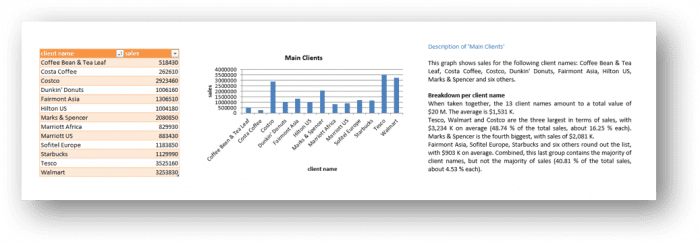
Yseop copy

Personalisation is taken to new heights by the NLG tool Wordsmith, owned by Automated Insights. In one case study, the basketball team Orlando Magic used it to create customised emails and in-app messages unique to each one of their fans, like the one below.
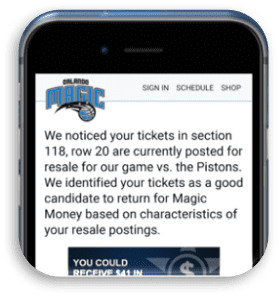
NGL tool Wordsmith AI copy


What does this mean for the future of writers?

I’ve been a copywriter for over twenty years, and the question everyone asks is ‘Are you worried that a robot will take over your job?’

Analyst Henry H Eckerson of Eckerson Group believes that will happen.

“In some cases NLG tools will reduce the number of people required to generate and analyze data. For business owners, this is great news: they can reassign staff to other jobs, increase their productivity, or lay them off”

AI vendors refute this, claiming that NLG tools augment, rather than replace, the writers and free up skilled staff to focus on higher value tasks, such as reading and acting on the reports generated.

Arden Manning, Senior Vice-President at Yseop says,

“None of us went to University to write data-driven reports all day long, but for many of us that is the reality. Asking highly educated analysts to write data-driven reports is a waste of time, money and human capacity.”

Jeremy Gilbert, Director of Strategic Initiatives at the Washington Post concurs:

"In no way do we want to replace human reporters with automated reporters," he said. "We want to free up reporters to do the kind of high-impact stories they want to do."

From my perspective as an experienced copywriter, I feel the same. It’s much more interesting to write a radio commercial or develop a new brand positioning than spend all day churning out standardized bullet points. There have been times when that’s actually made me feel like a robot!

But it was product descriptions that I cut my teeth on as a junior writer. If those kinds of writing opportunities disappear, how do the next generation of copywriters perfect their craft?  The industry as a whole will need to rethink training and qualifications for copywriters. If that helps humans stay smarter than robots, it’s got to be a good thing.


source https://www.smartinsights.com/persuasion-marketing/web-copywriting/yes-robot-can-write-advertizing-copy-heres/
5 essential social media listening tools and how to use them

The best social media listening tools to use in 2018 to help you develop your social media strategy


“The success of a relationship is solely dependent on two factors: a man's ability to listen lovingly and respectfully to a woman's feelings, and a woman's ability to share her feelings in a loving and respectful way.”
― John Gray, Men Are From Mars, Women Are From Venus


The core premise of Men Are From Mars, Women Are From Venus is that men and women communicate differently and in order for a relationship to be successful, they each need to be aware of how the other works.

Men, in particular, have to do a better job listening.

Not surprisingly, most brands suffer from the same shortcomings. Instead of listening to what clients and prospects are really saying on social media, many brands are content to simply broadcast their own messages over and over, effectively ignoring what could be far more productive, and profitable, conversations.

Why?

Well, it’s partly due to not realizing what and how to do it, of course. If you’ve never done a few searches on Twitter, you might not know that your customers & prospects are having relevant conversations.

And it’s partly due to not having the right tool in place, which is, of course, the purpose of this article.

Depending on exactly what you want to listen for, and how you intend to respond, there are a number of available tools which can ease that task, and perhaps even automate important aspects. We’re going to run through 5 of the most helpful, and affordable, social listening tools. Before we do, let’s make sure we’re on the same page regarding what social listening is and how it works.

What Is Social Listening?

We mentioned earlier that social listening has to do with paying attention to the conversations that your customers and/or prospects are having on social media. At a high level that’s accurate, but there’s more to it.

First, it’s important to realize that the conversations may be about your brand, specifically, or they may be about:

  • your industry
  • products
  • competitors etc.

Which means that sometimes - perhaps even most of the time - your brand will not be specifically mentioned in these conversations.

Sometimes people refer to watching for mentions of a brand as “monitoring” and leave “listening” to refer to more general conversations which might be of interest to a brand, but not about a brand.

This means that, regardless of whether someone’s talking about you and your business, or your products, or just something related to your business, you need to be able to see that those conversations are taking place, and be prepared to engage.

Which brings us to the second consideration: Engagement.

Social Listening doesn’t simply refer to getting a notification every time someone tweets about a problem your product can solve. It also refers to having plans, perhaps even specific text & information, in place to respond to those social posts.

It also means, just like in Men Are From Mars, Women Are From Venus, that brands need to listen respectfully to what the customer or prospect is saying and feeling. Your responses should be both helpful and empathic.

The tools will help you to find those conversations, but it’s up to you to guide them in positive, constructive directions.

What Tools Can I Use For Social Listening?

Each tool has its own set of features and benefits, and it’s own way in which it helps with social listening, so we’ll review the differences here. The tools are simply in alphabetical order.

Agorapulse

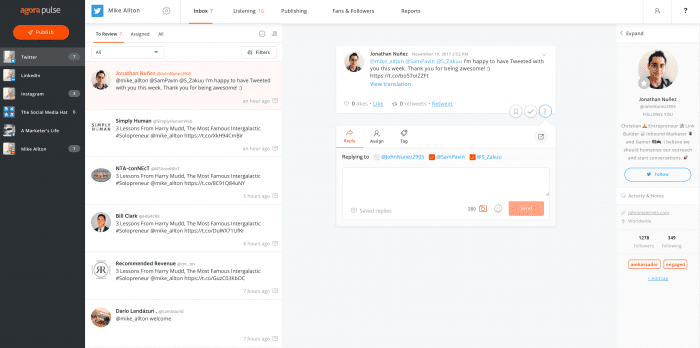
The Agorapulse method for listening is to funnel all mentions, comments, replies and saved keyword searches into a single Inbox so that you can swiftly review all of your messages in place. Twitter, Instagram, and YouTube can each have “rules” set up for Keyword/Listening that will actively monitor those platforms and deliver results to your inbox.

For instance, you can set up a rule for your Twitter profile that will show you any tweets that include a link to your site, letting you see people tweeting your content even if they don’t mention you.

You can search for words, phrases, hashtags or usernames. You’ll then get notifications on desktop or mobile for any new results, and can reply within the app or even assign to a team member.

Agorapulse-Listening

Hootsuite

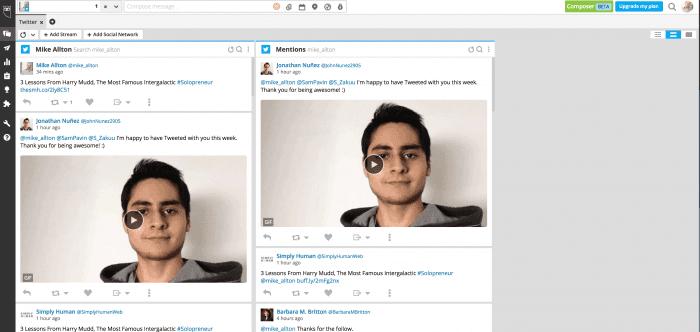
The Hootsuite method for listening is to use tabs & streams within your dashboard for each kind of listening that you wish to do. You might have a tab for your Twitter profile and within that tab, streams for Direct Messages, Mentions, and a few saved searches.

Like Agorapulse, you can search for words, phrases, hashtags or usernames. Hootsuite can monitor Twitter, as well as Instagram (Hashtags, Usernames), Google+ (Keyword), and YouTube (Keyword).

Hootsuite’s Twitter search is particularly powerful as you can limit results to specific geographic areas as well as languages.

Hootsuite-Listening

Sendible

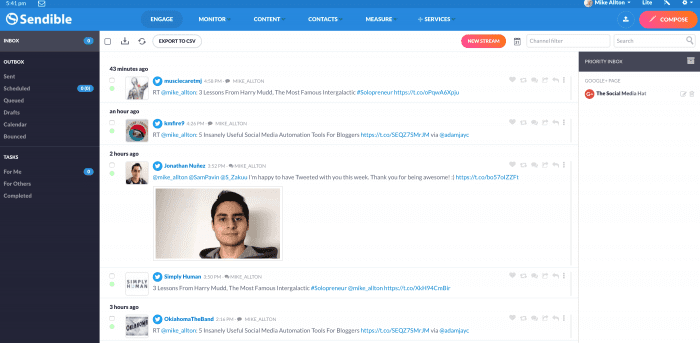
The Sendible method for listening is to split it into two areas: Engage & Monitor. Engage includes your normal replies and mentions, and is a single inbox for all connected profiles.

Monitor is for keywords and search strings and supports both Twitter and Facebook.

Sendible also incorporates a Library feature that helps you bring RSS Feeds, saved content and trending tags into replies - a real convenience when monitoring active search & keyword queries.

Sendible-Listening

Sprout Social

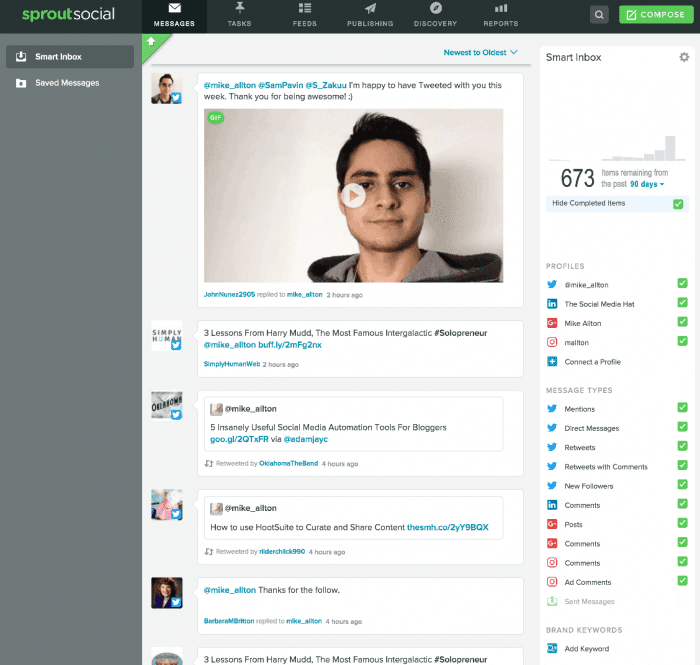
The Sprout Social method for listening also splits listening into a brand activity social inbox, versus a “Discovery” tab for keyword search.

Each time you set up a new search, you can indicate a geofence (i.e. 25km around Chicago) and save the search if it works for you. Saved searches are listed in the left side and support Twitter.

You can also set up brand keywords as part of your social inbox, and include Twitter keywords as well as Instagram hashtags.

SproutSocial-Listening

Zoho Social

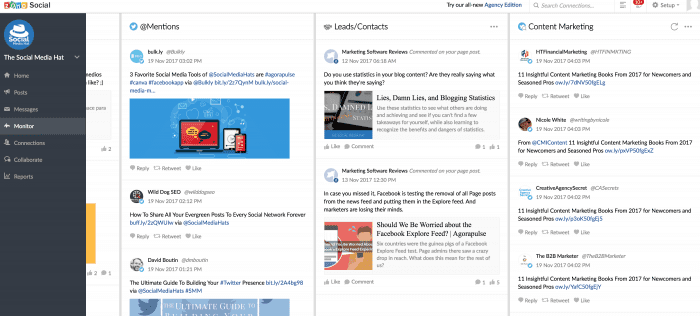
Finally, the Zoho Social method for listening utilizes a dashboard approach. You can add columns to the Monitor tab for a variety of purposes.

Zoho Social supports Twitter (Keyword, User), Google+ (Keyword, User), Instagram (Hashtag, User). Searches can be saved and filtered.

If you have teammates, you can discuss any particular social post within the app, as well as add individual social profiles to your Zoho CRM for future followup.

Zoho_Social-Listening

Wrapping Up

With those 5 tools, I’m sure you noticed some differences and similarities.

They all support Twitter, for instance, but some use an Inbox approach while others favor a Dashboard presentation of different columns.

All of the tools offer free trials so if you’re not entirely sure which one to go with, I recommend starting a free trial and then reach out to their sales staff to get up to speed on how to use the various search options.


source https://www.smartinsights.com/social-media-marketing/social-media-listening/5-essential-social-media-listening-tools-and-how-to-use-them/

Is Marketing ready for VR / AR in 2018?

The latest trends and innovations using VR / AR and interactive video to keep an eye on in 2018

Video is by no means a new marketing innovation, but it seems to be on the rise and considered the number one content consumption channel. It is still regarded as a highly popular method to distribute content to increase engagement rates across all digital channels. According to HubSpot's State of Inbound 2017 report, video is the main disruptor for marketers, yet YouTube and Facebook video are the 2 most popular distribution channels that marketers want to introduce into their strategy in the next 12 months.

future content distribution channel

However, it is important that these trends that are most popular are developed further with new and innovating ways to keep consumers engaged.

One trend we are seeing more and more of is the use of interactive video content - 360 videos, Augmented and Virtual Reality - the next progressive step from video providing an interactive customer experience. Now with Apple creating animojis, it seems like the first step (on a small scale) to animating yourself and sharing content in this interactive and creative way.

Although the travel sector has been using 360 photos and videos to showcase flights and exotic holiday scenery to convert users, sectors like retail, real-estate and social are now getting on the hype too.

It is important to have an up to date marketing strategy that integrates a multi-channel engagement cycle, to help conversions and build a positive brand awareness. But where will interactive video fit into your strategy for 2018 with the added possibility of introducing VR/AR to keep your audience engaged with your brand?

So where does VR / AR fit into 2018?

The use of Augmented Reality on mobile devices provides a niche and engaging way for marketers to reach their target audience - it's quick, easy and very interactive. The future of Virtual Reality in marketing remains uncertain as it requires a head-mounted display, making it much harder to reach potential customers without accessible hardware that is progressive as the VR software.

The virtual reality industry remains shaky for marketers, as it can be an expensive digital strategy that includes a head-mounted display, used primarily for the games and entertainment industry, at the moment providing little value for markers and B2B companies. I feel that the actual technology to make VR and AR is still developing, so it's difficult for companies to use it to its full potential until it's fully ready and available.

At Social Media Week 2017, Executive Creative Director Henry Cowling of UNIT9 talked of the future of Virtual Reality, stating

"The first step is finding out how VR fits into your marketing strategy, the second is convicing your audience to put a headset on"

These are the biggest challenges marketers face with the possibility of introducing VR.

Google Cardboard, a pop-up VR headset, was the highest shipped VR - a headset that focuses more on immersive 360 videos than full Virtual Reality.

VR customers

But can mobile AR conquer the current AR challenges?

"The phone is probably going to be the mainstream consumer platform [where] a lot of these AR features become mainstream, rather than a glasses form factor that people will wear on their face" - Mark Zuckerberg, TechCrunch

Brands have already dabbled in interactive video on desktop and mobile, including 360 videos, but now brands like Ikea are taking the next step and launching product AR apps and social platform AR lenses to capture audience's attention, yet the future of VR remains elusive.

Let's take a look at some brands that are starting to innovate in the latest interactive video and AR trends - something to watch out for further in 2018.

IKEA, Augmented Reality furniture app

Have you ever bought a huge piece of furniture, don't like it and had to speak to 3 different people and fill out 2 return forms to send it back?

Ikea is now rolling out 'Place' an app for iOS users to preview furniture in their home before buying! This type of AR integration with ecommerce is ingenious as Ikea seeks to increase conversions by showing customers how their products will look in the surroundings of their own home, before buying.

ikea place example

The use of AR is essential to customer engagement, with users being able to walk around and place furniture and objects into the settings of their home. This type of advertising is a milestone in persuading customers that the furniture they are thinking of buying looks good in their home and if it doesn't? Well, you'll be able to preview another object until you find the right one.

The app is part of Apple's new Augmented Reality developer platform, ARkit, (part of October's iOS11 software update) which helps developers create apps that merge real-world imagery with digital and augmented objects. It is unsure whether Android users will be able to use Ikea's app in the future, as Google's Augmented reality platform Tango isn't automatically included on every android device.

Is this taking the fun out of the Ikea in-store customer experience (and meatballs) or a more practical, interactive and persuasive technique to convert users into buyers?

No more awkward returns!

John Lewis, 360 shoppable Facebook Ads

Innovators in video advertisement, many viewers eagerly await their Christmas advert. New to their video strategy this year, although neither Augmented Reality or Virtual Reality, UK retailer John Lewis are following a similar approach to that of Ikea. Their 360 shoppable video Facebook ads - a new and innovative idea they are trialling this Autumn - is similar to Ikea's Place app. If successful, it could pave the way for 360 interactive and shoppable videos on Social Media.

This approach attempts to enhance customers and social media users' interactive shopping experience - showcasing products in real-life house settings before buying.

This new video social strategy will offer customers with more interactive experiences than normal, or tradition, ecommerce shopping.

John Lewis' Senior Manager for Social Media told Marketing Week:

"It is such a new format, it’s hard to calculate a ROI or bench mark, but I imagine the key here will be a mix of engagement and click through to sales"

John Lewis 360 shoppable facebook ads

But with the launch of this new innovation how well is it doing? John Lewis has over 1 million followers on their Facebook Company page, yet for this new type of content, it only received 11k views and less than 100 reactions.

It's great to see products in a home setting rather than a shop floor, or a generic picture for your ecommerce landing page - but it doesn't have the same personal touch as Ikea Place.

Snapchat 3D World Lenses

Rival photograph and video platforms, Instagram and Facebook stories, are slowly taking over the video social world from the original creator, Snapchat. More and more filters are being created to keep users interested and engaging with the social platforms, but Snapchat has announced a new direction for interactive filters - Branded 3D objects in Snapchat posts.

It seems they have been trialling this with their well-used and well-received dancing hotdog

This type of AR real-world lense allows brands some creative fun in their social strategy and consumers interactive engagement with branded 3d objects.

Snapchat first released sponsored posts when brands could purchase a unique branded filter, then launched 2D sponsored lenses, which were a little more interactive and more fun.

But in a recent bid to win over and get users interacting with brands, they have announced 3D world lenses. All 3D lenses can only be purchased through the Snapchat sales team. This is predicted to help brands increase awareness and engagement, whilst also reviving the social platform by doing something different from its competitors.

Giraffe360, Virtual Reality technology for real estate

A relatively new startup company based in London UK, Giraffe360 technology:

"enables the real estate industry to elevate property viewing into a virtual reality experience". - Startup Guide

Brothers Mikus and Madars Opelts started their virtual tour service in 2010 and in 2015 turned over 500k.

Their VR software is design to create high-resolution HDR images that will help showcase a property anywhere in the world.

The use of VR for the real estate industry is a great idea if you're targeting an audience that would normally drive a long distance for a viewing. But, it can also help create a real-life virtual image of what new / developing properties will look like before they are finished.

Leeds, UK, based real estate company Citu is also building a fully immersive VR experience to show potential customers around new housing developments before it has been built, meaning real estate firms can always be virtually selling.

AR / VR forecast

It's evident that companies are beginning to test the waters and trial different interactive video formats and experience, yet the projection for AR revenue by 2020 is set to outweigh VR by $120 billion.

arvr-forecast

Although the forecast for AR / VR revenue increases Y-O-Y, I still remain sceptical about the rate and potential use of AR / VR for some industries. Whereas it shows huge potential for travel, real estate, retail and the games and entertainment industry, it is unclear how, why and even if this type of video interactive content can be applied to other industries like finance, agency, and B2B.


source https://www.smartinsights.com/digital-marketing-platforms/video-marketing/is-marketing-ready-for-vr-ar-in-2018/

Friday, 24 November 2017

Buying Online is Now Mobile-First

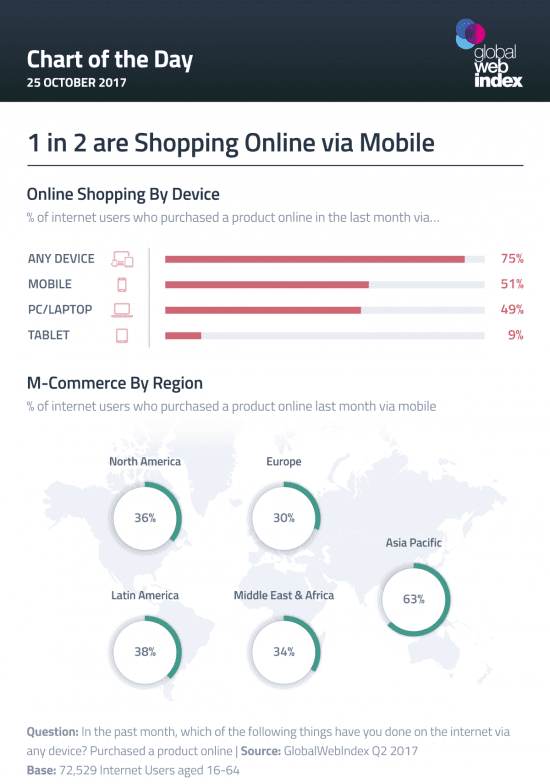
Chart of the day: 1 in 2 are shopping online via mobile

Global Web Index' latest research confirmed that online shopping has now become a mobile-first activity. This change indicates the changing behaviors towards online shopping as more users turn to mobile.

According to Global Web Index mobile will 'pave the way for location-based retail, AR shopping experiences, social commerce, and mobile payments to take on a more prominent role in the consumer’s path to purchase'.


source https://www.smartinsights.com/mobile-marketing/buying-online-now-mobile-first/

Top 10 digital marketing tips from 2017 [infographic]

The best digital marketing tips from 2017 at the 3XE conference

The 3XE Search – Digital Marketing Conference, was one out of a series of three educational conferences focused on different aspects of digital marketing. The event took place at Croke Park, Dublin, home to Gaelic Athletic Association, it provided an eye-catching and functional venue for the conference.

Focusing specifically on Search marketing the day consisted of presentations from leading digital professionals from all over the world, broken up with selected workshops on how to plan and implement your digital marketing campaigns. The 3XE Digital series has grown massively over the last few years and has become a must-attend event for digital marketers.

With a total of 15 presentations covering all elements of Search, the expert advice we picked up was second to none. A key theme throughout the day was the changing way in which consumers use search and the introduction of new technologies and what effects these would have on search marketing trends. An example of this would be the increase in the use of voice search and the realization that new generations will grow up with this level of expectancy. It will be key to adapt to these new ways of search in order to be successful in digital marketing strategies.

Virtual and Augmented reality was also mentioned a few times throughout the conference – with some great examples of when VR headsets can get pretty serious (aka walking into walls).

Overall it was a very successful event, with some invaluable advice and tips from world-renowned experts.

When-We-Are-Promotional-Products-Visited-3XE


source https://www.smartinsights.com/digital-marketing-strategy/digital-strategy-development/top-10-digital-marketing-tips-2017/