Thursday, 4 January 2018

Social media updates that shook 2017

Social Media Essentials:

Happy New Year to all our readers. Last year we saw some exciting social media updates here are our top 3:

  • Instagram rolled out their “paid partnership with” tag. Allowing influencers to clearly mark the image as paid and it will also do the same on stories. This feature was a great move on Instagrams behalf as it increases transparency on the platform and enforces the new rules being put in place by The Federal Trade Commission. Who are looking to clamp down on social media campaigns that mislead consumers.
  • We also saw Twitter expand their tweets from 140 characters to 280. Their reasoning for expanding the character count was because, for those tweeting in some languages such as Japanese, Korean or Chinese, they require fewer characters than tweets in English or Spanish. Twitter believes that when people have more character they are more likely to tweet.
  • Facebook announced they would allow you to share Instagram stories to your Facebook stories straight from inside the Instagram app. Making Facebook the most popular social media platform globally.

What do I hope to see in 2018? Hopefully editable tweets (why has this not happened yet?), less fake news and stronger social media policies. But now on today, we cover all the key updates that happened between Christmas and now in the world of social media.

Facebook Penalizes “Engagement Bait” Posts in the News Feed

Facebook is cracking down on engagement bait. If you're unsure what this means you may have seen phrases such as 'Like this if', 'Share if you' and 'Tag a friend who'. Facebook will downrank these posts in users news feeds. As a result post such as these will be seen by fewer users and receive lower rates of engagement. In addition to downranking individual posts, Facebook says that pages that continually use engagement bait tactics will be penalized.


Facebook will now demote posts from people and pages that use “engagement bait and has reviewed and categorized “hundreds of thousands of posts” to inform a machine learning model to detect different types of engagement bait.

Instagram Tests Five New Fonts for Instagram Stories

Instagram has been testing five new fonts for Instagram Stories with users in Japan. According to Social Media Examiner, they are reportedly being called Modern, Neon, Typewriter, Strong, and Classic. Instagram has yet to confirmed this update so keep a eye out for any new fonts.

Best Nine photos

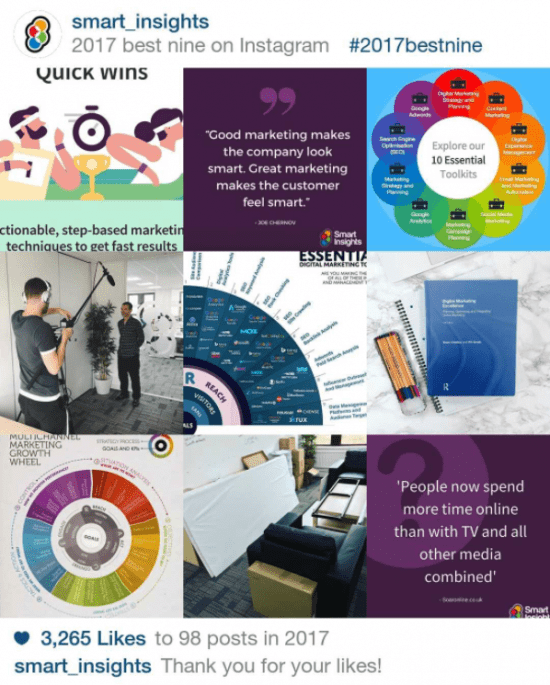
You might have noticed a new end-of-year trend on Instagram, user sharing their best 9 photos from 2017. Thanks to 2017bestnine.com, a website that lets you automatically collect and collage your most-liked photos of 2017. Here are Smart Insights Instagram highlights, if you don't already why not follow us?

Snap review your year

Snapchat users who snap and save can take a stroll down memory lane with the app’s new feature, “A Look Back at 2017.” You can find your 2017 year in review in the memories tab.


Instagram now lets you share live videos through direct messages

 Instagram annouced they are rolling out another change — users can now privately send live videos over Direct Messaging. This includes your own live video, the company says, or you can share a live video you’re currently watching with a friend or group of friends. Instagram is improving its direct messaging feature and it has been speculated that they will be launching messaging into its own, separate app.

Virgin Trains apologizes for 'sexist' tweet

You often find brands on social media using humor and sarcasm to reply to customer inquiries and questions, this often receives great response from their audiences. But this wasn't the case for Virgin Trains when they replied to a customer complaint with a patronizing response. The tweet sparked a debate on social media.


A spokesperson for Virgin Trains on the east coast route said: "We apologize unreservedly for this tweet and for the offense caused. To avoid causing more offense we have deleted the original post." The lesson to be learned here? Be careful when responding to customers and ensure your response is helpful and not offensive.

What do you think of Virgin Trains response? Will Facebook cracking down on engagement bait affect your business? Let us know what you think and connect with us on Twitter, Facebook, Instagram or LinkedIn. Don't forget to join us next week for another weekly roundup.


source https://www.smartinsights.com/social-media-marketing/social-media-updates-shook-2017/

How to structure a product launch campaign

How to plan your product launch using the RACE planning framework

You are working during one of the most entrepreneurial eras in history. Thanks to digital media, launching a product to a global audience has never been so manageable. Equally, competition has never been as fierce.

Our product launch campaign playbook will guide you through the process of how to successfully launch your product online.

It considers how to avoid common pitfalls encountered when launching a product and how to promote your online launch. These pitfalls commonly involve missed opportunities to reach or persuade your audience through the customer lifecycle. This visual shows all the potential interactions that can be used during a product launch across the touchpoints of the customer lifecycle. Use it as a visual checklist of what’s required.

customer lifecycle - B2C retail

The reason we created our launch plan guide is simple, it’s a common ‘use-case’ in marketing. All businesses create new products or new propositions to increase revenue and appeal to different audiences. It’s particularly relevant for startups when they first launch.

Planning helps you explore potential opportunities for your launch, define aims and prepare your launch timeline.

Creating a campaign plan empowers you to prioritize resources in a logical and effective order.  With a product launch, as with so many issues related to business, whilst you can plan for most eventualities, you should also plan for the unexpected.

How to structure your campaign plan

You may know the Smart Insights RACE Planning framework which covers five parts which are essential outcomes of a marketing or digital marketing plan, they’re Plan – Reach – InterAct – Convert and Engage an audience. For this Playbook, the framework is broken down into 25 more detailed activities for you to review in a checklist format. For each of these 25 activities there we recommend specific actions to take and resources and tools giving more details.

The five parts of RACE planning will help you:

  • Plan your launch
  • Reach your market
  • Act through encouraging participation
  • Convert by turning casual surfers into customers
  • Engage by turning casual customers into loyal advocates

RACE planning framework - landscape

Plan for the worst

With so many variables, it would be foolish to suggest you can always be fully prepared for anything. However, by reviewing the risks and defining steps to mitigate them you will be able to remain in control of each stage of your launch, even if the unexpected happens, you’ll be ready to respond to it coolly, rather than react on the spur-of-the-moment.

Your vision and how to reach it

Depending on your intended market, you will need to develop a clear all-encompassing vision. Each aspect of your product launch vision is supported by a substantiating statement.

Example – consumer

To become the bestselling maze-building gaming app.

Every maze is based on highly accurate maps of some of the world’s most popular actual mazes.

Example – B2B

To become the most trusted online small business accounts software platform you can buy.

Our software package has been developed in partnership with each of USA’s top three small business accountancy practices.

Having crafted these statements, it's time to consider ‘how to get there’ strategies:

Example – consumer

To become the bestselling maze building gaming app.

Every maze is based on highly accurate architectural drawings of some of the world’s most popular mazes.

PLANNING:

  • Develop brand awareness.
  • Design a social media strategy.
  • Create a viral marketing campaign.
  • Agree budgets, targeting appropriate audience, testing and metrics.

Example – B2B

To become the most trusted small business accounts software platform.

Our software package has been developed in partnership with each of USA’s top three small business accountancy practices.

PLANNING:

  • Build a personalized email strategy.
  • Implement online PR campaign.
  • Create online small business advice platform.

Agree budgets, targeting appropriate audiences, testing and metrics.

What is it? Who are you? Where are they?

You are intimately familiar with every aspect of your new product.  However, the same cannot be said for your prospective markets and audience.  Initially the most important of these markets are ‘early adopters’, particularly where you are launching into a relatively new product category.

During the first phase of your planning, beyond simply considering what your product is, think about how and where it fits on the ‘radar’ of your early adopter marketplace.  This is crucial.  Not only does it help ensure the features and benefits of your product are understood, but importantly, it sends out a signal that helps early adopters distinguish your offering against competitors who may produce a similar product.

From the outset, your phased campaigns need to incorporate distinctive messages which help early adopters justify making a purchase - whilst at the same time empowering them to tell others just how brilliant your product is, and why they are proud to boast being amongst the first to own it.

Creating a campaign timeline

Draw up a timeline covering the build-up, launch, and post-launch, mapping each stage against benefit messages aimed at specific markets, along with benchmarks against which you can explain any value propositions against competitors.   Keep in mind that your online (consumers) first concern will always be whether your marketing helps them make informed decisions and choices.

When developing your timeline, consider how you can work with potential influencers early on.  Online, this has far-reaching implications that extend to how and where you promote your product. For example, which influencer blogs should you have in your sights?  How about podcasts and trusted journalist reviews…

Using tracking KPIs to review audience engagement

It will help to define launch performance indicators for an agile launch. When launching a new product, as with any campaign, you will want to define success criteria, but it’s particularly important for a new product launch since uncertainty means you will need to adjust your approach

Key performance indicators include:

  • Video downloads.
  • Infographic downloads.
  • Brochure downloads.
  • Click Through Rates
  • Volume-based KPIs
  • Total revenue from customers acquired through online marketing.
  • Cost Per Lead.
  • Customer value.

(Calculated by the average sale per customer x the average number of times a customer buys per year x the average retention time in months or years for a typical customer.

Building the option to update or upgrade a product over time can enhance your income revenue stream).

  • Mobile leads, traffic, and conversion rates.
  • Social media traffic and conversion rates.
  • Organic traffic.
  • Landing page conversion rates.


source https://www.smartinsights.com/traffic-building-strategy/campaign-planning/structure-product-launch-campaign/

Wednesday, 3 January 2018

5 secrets of highly referrable brands

Referral marketing is a great way to harness the love that customers have for your brand and in turn drive new customer acquisition

Research consistently shows that consumers are most likely to listen to recommendations from friends and family than traditional advertising channels.

Of course, for someone to refer your product, it needs to be something they love and believe their friends will love too. Nobody wants to put their name behind something that might damage their reputation.

Whilst a quality product or service means that refer-a-friend can drive new sales, there are some elements which can take referral to another level.

So, what are the secrets of highly referable brands?

1. Unique

Disruptor brands typically identify a pain point for customers and seek to remedy it with a unique solution. These brands tend to extremely referable. Not only are they solving an issue with a great customer experience, people love to share something they feel they have just discovered.

One such brand is Bloom & Wild, recently reported to be one of the UK’s fastest growing tech firms. They pioneered letterbox flower delivery overcoming the pain of discovering a missed delivery or damaged blooms.

So referable is the brand that the Bloom & Wild refer-a-friend programme consistently delivers 15% of new customer acquisition, rising to 30% in peak months.

Bloom and Wild

2. Trend Setting

In all areas of commerce, fashion is perhaps the most personal in terms of expressing taste, identity and individuality.

Fashion is social by nature. We share, compare, discuss and complement each other on new items. We ask for trusted friends’ opinions on certain looks and styles ahead of future buying decisions. In other words, we place trust in our social circles to shape and reinforce our buying habits.

The social dynamics at play, therefore, make fashion brands that set the trends, highly referable. Typically, the more luxurious and exclusive the fashion brand, the higher the rate at which it will be shared.

A great tactic used for trend-setting brands is to offer the chance to be part of an exclusive event in addition, or instead of a money off reward.  This ties into an increasing trend to value experiences over possessions. This can be a useful approach for luxury brands which might frown upon discounting.

Refer a friend trend setting

3. Limited Edition

Brands which offer products or services which are available in a limited quantity create a buzz which referral can really tap into. It plays into the psychology of persuasion, first written about by Robert Cialdini.

Scarcity is one of the key persuasive ingredients which compels shoppers to act, as people will desire something if it is seen as less available.

Online furniture retailer Swoon Editions have built this into their business model by producing limited edition ranges of furniture.

Their referral programme has proved highly effective as their case study demonstrates.

Swoon Editions

Brands which do not produce limited edition products or services can still tap into the influence of scarcity. Many referral programmes provide rewards which must be redeemed in a short timeframe, thus driving the need for urgency.

4. Technical

The most innovative technology products tend to succeed or fail on the buzz created by early adopters.

This group wants to be ahead of the curve and strive to be among the first to own the “latest” product, particularly new technology.

They are tech savvy and opinion leaders, keen to share their knowledge with their peers. Therefore, they tend to be the best brand advocates.

Every referral is driven by psychological drivers. In this case, the social capital associated with telling a friend about new technology which means that the referrer is seen as an expert on the product.

Indeed, recent research carried out by OnePoll for Mention Me showed that technical products are one of the most referred category of product for males, with 55% saying they were likely to refer such products.

5. Fun

It sounds obvious; friends want to share fun experiences with each other, not just the mundane aspects of life.

It follows then that they are also likely to share a product or service that is seen as entertaining. Indeed, research shows that experiences such as travel, entertainment and leisure are some of the most likely categories to be referred.

That doesn’t mean that referral isn’t successful in other categories. The key is to make the messaging surrounding the offer fun or entertaining.

One great example of this is cosmetics company Benefit. Every aspect of their marketing is irreverent and playful, and this extends to their referral programme. The copy, images and referral offers all reflect this approach and has driven successful customer acquisition with customers acquired by recommendations being a particularly valuable segment.

Even if your brand doesn’t exhibit one of these 5 elements, the key to referral success is to tap into the underlying concepts in your refer-a-friend campaigns. So make your messaging and creative, fun, unique or sought after. Most of all, make it something worth talking about.


source https://www.smartinsights.com/digital-marketing-strategy/5-secrets-of-highly-referrable-brands/

International mobile and desktop social media reach benchmarks

Chart of the Day: Compare desktop and mobile social media platform reach benchmarks across various counties

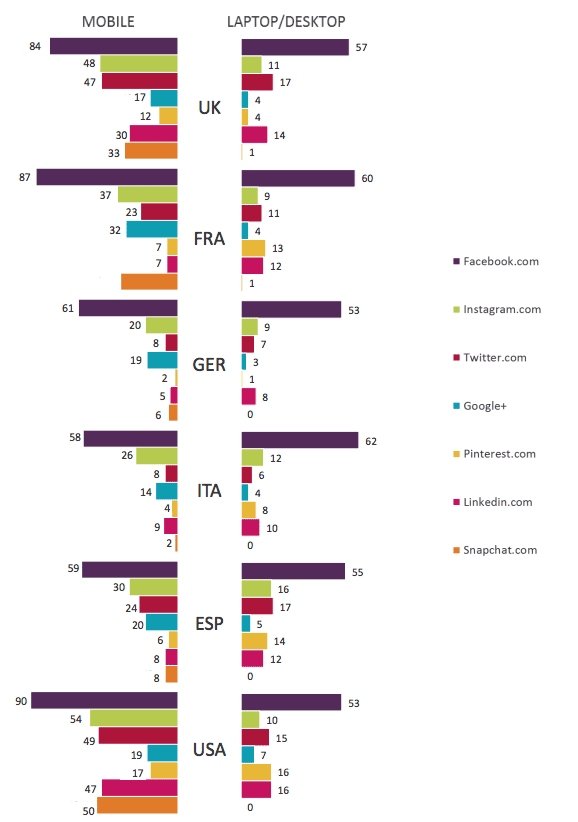
In a recent report by Ofcom, 'The international communications market 2017', global comparisons of social media reach has been revealed. The use of social media in marketing is vastly popular because of the potential reach of worldwide customers, and although it's become a 'pay-to-play' arena for most businesses, there is still potential for organic reach if used correctly and strategically.

With the vast range of social media platforms readily available for marketers and advertisers to promote their products and services, one of the hardest challenges is determining which platform is best. However, not only do you need to know which platform your target audience is using, but which device they using and what geographical demo-graph is most popular to get a holistic view of where you need to target. All this customer research is vital to achieving a well executed social media strategy plan that reaches audiences.

International mobile and desktop social media reach

As shown, Facebook is the widest-reaching social media network among all countries compared - its reach is far higher than any other social media network on desktop and mobile.

The visual social platform, Instagram, is the second widest reach on mobile. This isn't surprising since Facebook acquired Instagram in 2017 and was primarily created as an App that has only just started to branch out to desktop, with limited similar working features. Much like Instagram, Snapchat is primarily used on Mobile as an app - however, what is surprising is the popular usage of Snapchat in the United States. Since Instagram released 'Instagram Stories' it becomes a direct competitor and saw it's users level out rather than rival Instagram's growth.

However, the use of social networks in the USA and UK is far higher on mobile than desktop. Showing, more than ever, that companies need to take mobile responsiveness seriously and start optimizing for this device or else they risk users quickly bouncing off their site.

What does this mean?

As of September 2017, Facebook announced in their Third Quarter 2017 operational report that there was 1.37 billion daily active users, an increase of 16% year-over-year. Using Facebook to help increase potential reach and awareness of your product is vital - after all, you can use this for free. It is a great way to set up company pages and communities for customers to help reach and engage customers in your product or service. This report shows that if you plan to invest in at least one social media network, Facebook would prove to provide the widest reach of potential customers (just make sure your customers are using Facebook - if they aren't it may be better to invest in another social network).


source https://www.smartinsights.com/social-media-marketing/social-media-strategy/international-social-media-reach-benchmarks/

10 Marketing Trends to act on in 2018

How to integrate digital media and technology to increase the contribution of digital marketing

I feel fortunate to have followed some of the amazing major changes in digital marketing and technology over the last 15 or 20 years. I'm sure you will have enjoyed living through, following and acting on these changes too. Looking back, we've seen a phenomenal growth in the importance of organic, then paid search, then social media and more recently, incredible worldwide growth in mobile and particularly smartphone usage.

As well as this article, to help Smart Insights members, we also have a more detailed free download of the marketing megatrends, which are 9 digital marketing and martech megatrends that will help give you an edge in 2017.

Looking forward, in this article, I'm going to review 10 new trends which I believe, based on my experience consulting and training, are relevant for marketers across businesses of a range of sizes. But, first, I'm interested to know what you think will be important to you and your business in 2018.

Which marketing trend will be most important to you and your business in 2018?

We have asked this question over the past few years and it's been really interesting to see what 'rocks your digital world' since there are some common themes amongst the top 3 and some activities surprisingly low. The question we asked was around the most important commercial trends. We had around 850 votes from marketers in different types of business from around the world. Thank you if you voted! Here's what you thought:

By asking for just one technique from many, this helps shows the top 3, 5 or 10 top-level trends. There are a clear top three techniques, each over 10%, but with a long tail of many other techniques showing the potential for optimising different areas of digital marketing. Let's take a look at the top three...

It's no surprise to see content marketing 'top of the pile' since this has been in the top three for each of the years we have run this poll. We see content marketing as the 'engagement' fuel that powers all digital communications from search to social to email marketing to creating website experiences which convert. Our content marketing toolkit is popular since members want to learn a more planned approach to mapping content against personas across the customer journey.

More of a surprise is that Big Data is in second position. I think this is because marketers are aware of the potential of using data as what we call 'actionable insight'. To help the decision on which technique to choose, we expanded upon the short labels you see in some polls to help scope the response more carefully. 'Big Data' is a nebulous term, but when we expanded the definition to include insight and predictive analytics, it shows the value of the specific marketing techniques for Big Data and this help explains why this is in position number two.

In third position is Artificial Intelligence and Machine Learning. We added this to the poll this year with the interest in it and it's 'straight in at number three'! It's good to see the interest in these techniques which we have been covering a lot on the blog and in our member resources this year. In trend 8 we show how different AI techniques can be mapped against the customer lifecycle.

Here is the full listing of digital marketing techniques:

The ten marketing trends to act on in 2018

If you look at the 14 themes that we covered last year, none of these top-level marketing techniques are especially new, so it's difficult to describe them as new trends or innovations. However, techniques like Big Data and analytics, Content Marketing and Email/Marketing Automation have continued to grow in importance and will be used by many businesses.

So in my look at the trends this year, I'll be looking at integration as the theme. In our research on managing digital marketing (another free member download) you can see that only 6% of companies thought their integration process was completely optimised, yet many are actively working on integration.

Integrated marketing communications or IMC isn't a concept you see written about much on blogs or social media since it's high-level with everyone getting excited at the latest minor innovations from the frightful 5 - at the time of writing we're getting excited about the Animojis in iPhone X for example. Fun, but they're not going to help deliver the most relevant message and offer for an individual, which is the aim of IMC.

So, let's take a look at the 10 trends. You'll notice that in a lot of these predictions, I'll refer to Artificial Intelligence and Machine Learning. It's what I see as the biggest trend to consider in the year ahead. There has been a lot of hype around it in 2017 and we're starting to understand the opportunities. In 2018 it will become more about selecting solutions and implementation.

Trend 1. Integrating Marketing Activities Into the Customer Lifecycle

Given the way the complexity of marketing and digital marketing has increased, techniques like customer journey mapping for different personas are increasing in importance to help define the most relevant communications and experiences for different touchpoints in the customer journey.

To support this, the way I like to think about how to improve the effectiveness of digital marketing is to think from the customers' viewpoint of the communications opportunity available through the customer lifecycle for different types of business.

We define lifecycle marketing as:

Creating a managed communications or contact strategy to prioritise and integrate the full range of marketing communications channels and experiences to support prospects and customers on their path-to-purchase using techniques such as persuasive personalised messaging and re-targeting.

We designed this mind-tool to help members think through all the potential touchpoints across paid, owned and earned media. Then you can perform a 'gap analysis' of the use and effectiveness of lifecycle comms you are using against those you could be using to increase the relevance and response of communications.

Trend 2. Integrating personalization into the user journey / customer experience

To increase relevance and response of comms, website personalization has been widely used within transactional ecommerce sectors like retail, travel and financial services for a long time now.

More recently, lower cost options have become available with different types of solutions. There are many forms of web personalization varying from those integrated into content or commerce management systems; those integrated into analytics solutions or standalone Software as a Service (SaaS) personalization options that integrate with your CMS and analytics. A useful method to review your use of personalization at the top-level is this experience personalization pyramid:

the Personalization Pyramid

The three levels shown in the chart are:

  • 1. Optimization. Structured experiments. AKA AB Testing or Multivariate testing. Google Optimize is an example of one of these services that launched in 2017.
  • 2. Segmentation. Target site visitor groups, each one with specialized content to increase relevance and conversion.
    Each one still requires separate manual rules and creative to be set up. So returns for this approach eventually diminish after the maximum sustainable number of audience segments has been reached.
  • 3. 1-to-1 Personalization. Using Artificial Intelligence (AI) technology to deliver an individualized experience to each customer. 1-to-1 employs some of the same principles as optimization and segmentation, but by offering a solution to their two greatest limitations-delayed results and inability to scale-it represents a fundamentally different approach.

So, the main trend within personalization is increased use of artificial intelligence rather than manual rules. Plus, we can also expect to see Website personalization services being adopted across more sectors than the transactional sectors it has become popular within.

Trend 3. Integrating machine learning into marketing automation

Personalization can also be applied across the lifecycle in email comms.  Yet, our research on email marketing shows that despite the widespread use of email and marketing automation systems, many companies don't manage to put in place a full lifecycle contact system like that shown in the lifecycle visual above.

We assessed segmentation and targeting of emails based on the number of criteria that are used from none at all up to dynamic content.

The findings from our State of Email marketing report are shocking: Half (50%) don’t use any targeting whatsoever, less than a third (29%) use basic segmentation for targeting and less than 15% use segmentation and personalization rules to reach specific audiences within their database. This means that they may be missing out on opportunities for automated emails with dynamic content for welcome and nurture of prospects and customers.

Although email marketing automation is another technique where artificial intelligence and machine learning is being applied more often. Using machine learning offers opportunities to automate targeting as it does for web personalization. However, personalization is potentially more difficult since emails, by their nature, have more complex creative. This data suggests to me that many businesses aren't ready for AI and machine learning within email marketing and they need to deploy fundamental triggered automation features first.

Trend 4. Integrating social messaging apps into communications

The increasing use of messaging apps is a trend we have mentioned in previous trends round-ups. According to the latest Ofcom Communications Market research more than half of the total mobile audience used Facebook Messenger (61%) and half used WhatsApp (50%). Both properties are owned by Facebook. The Snapchat mobile app had a reach of 28%, with 10.1 million unique visitors.

We've been looking at some early adopters of marketing applications of these social messaging apps on Smart Insights. Examples include using Pizza Hut using Messenger for booking tables and IKEA for customer research.

Trend 5. Integrating video into the customer journey

Video is also increasing in popularity fuelled by social . This breakdown of Google popularity shows the dominance of YouTube. We used to say that YouTube was the second biggest search engine, but this data shows that it is now more popular than Google Search based on number of users in a given month (this research also from the comScore panel via Ofcom).

This visual reminds us of the opportunities to use video marketing through the customer lifecycle from pre-roll ads in YouTube (just one option, Google has 10 Video ad options), explainer ads on site and retargeting through video.

Augmented and Virtual Reality are closely related to video engagement, but although we've been tracking these, we have seen fewer examples and case studies this year. So, do let us know of any examples.

Trend 6. Integrating content marketing into the customer journey using a customer engagement strategy

Video is just one type of content, albeit important. In previous polls about the technique that will give the biggest uplift in future, content marketing has been popular, in the top one or two in the list.

The trend I'm seeing here is that businesses are getting serious about treating content as a strategic resource, that means developing a customer engagement strategy using different media as shown in the lifecycle diagrams above, and at a practical level, developing content for different audiences using techniques like Personas and Content mapping. Our research shows that these customer-centric analysis techniques are growing in importance, which has to be a good thing for consumers and businesses!

Recommended resource: Content Marketing Strategy guide

Trend 7. Integrating search marketing into your content marketing activities

If we look at the top digital sales channels, search marketing is dominant. Social media is far behind in most sectors, despite its ongoing popularity with consumers. We now know that in many sectors social media can be a great tool for engaging audiences with a brand and improving favourability and awareness, but it typically doesn't drive lead volume or sales. So I haven't given social media it's own section, although integrating it with other channels like web, search and email marketing remains relevant. See our recap of SMW London for the latest social media trends.

However, within search marketing there is today relatively little innovation that we get to hear about compared to the past. Looking at natural search shows that the Moz algorithm change history has no entries since the non-specific 'Fred' update in March, whereas in previous years it would have had 5+ with new updates to Panda and Penguin. This is partly down to Google sharing less, with Matt Cutts no longer actively evangelising, although updates are available from John Mueller in their Search team.

Within organic search, one trend I think marketers should be aware of is the changing face of the SERPs as shown by the Mozcast SERPs features update which shows the types of links within a bundle of top 10k keywords they monitor.

It shows the importance of techniques such as Knowledge Panels (important for brands and local businesses); Related questions; featured / rich snippets / quick answers and reviews. We have found that the way these vary across the top 3 to 5 positions can make a big difference in the volume of visits from informational searches.

Within AdWords, referencing Google's list of new features shows more innovation. Much of it is around reporting compared to new ad features for mobile in previous years, but there are some new options like with Enhanced CPC (ECPC) bidding and Smart Display campaigns. This is an example of Google deploying different types of machine learning including Automated bidding Using Target CPA as a basis; Automated targeting which means your ads increasingly show where they’ll get you the most business and automated ad creation from the building blocks you provide, like headlines, descriptions, logos and images.

Trend 8. Integrating marketing technology

If you follow applications of marketing technology you have almost certainly seen Scott Brinker's Martech landscape which has grown to over 5,000 vendors this year.

Our own digital marketing tools wheel seeks to simplify this, but has over 30 categories of insights and automation tools which shows the challenge of integrating marketing technology. The trend here is that there is no let up in tools offering innovative methods to analyse or automate. Our final two categories highlights some of these.

Given the plethora of martech, the most apt definition seems:

'very large amount of something, especially a larger amount than you need, want, or can deal with'

You might expect there would be a trend to increasing use of marketing clouds, but our research suggests there isn't widespread adoption of these.

As we have mentioned throughout this article, machine learning and AI is one of the biggest trends here, see this article and infographic for AI marketing applications across the lifecycle.

Trend 9. Integrating different data sources

This challenge was highlighted to use recently in our members' Facebook group where a member asked about tools for integrating insights from different paid media ad serving tools which can give the best results if managed separately, for example, Facebook, Twitter, LinkedIn ads and Google AdWords. Rivery.io is a new option that has launched recently, that should do well. The trend here is new integrated media insights tools other than Google or Adobe, which can help you compare performance of different media.

These services are surprisingly expensive, particularly since they are additional analysis tools. They're not martech that directly increases leads or sales to the business. For example, I was recently recommended this service (Funnel.io ) that costs a minimum of $200 / month, even if it's solely used to integrate data from multiple sources into Google Sheets. It's a lot when to get the value from these tools you have to ringfence time so that the analytics are reviewed and acted on sufficiently.

Trend 10. Integrating digital marketing insights sources

Our digital marketing tools wheel contains many free and paid sources of insight about your digital marketing. Here, I'm talking specifically about services which help you stay up-to-date. We're avid users of these services since they help us keep readers up-to-date via our own blog, twice weekly newsletters and monthly What's Hot feature.

In a recent article on keeping marketing teams up-to-date, Mark Kelly explains that we recommend using Feedly as a way of aggregating primary marketing news sources via RSS. Plus, I recommend taking a look at Zest which is a Google Chrome extension, new in 2017, which I and the team at Smart Insights use and is well worth checking out. Its curated content is specifically designed for and updated by marketers. Like Feedly, you can use it to review the most useful content recommended by 'the crowd', in this case 'your tribe' of marketers.

Summary presentation

To give you a different format to view some of the visuals, take a look at this Slideshare

It all adds up to digital transformation

So, those are the 10 trends summarizing how businesses are looking to manage the opportunity of digital media, technology and data by integrating it into their marketing. This brings us to our final trend, digital transformation. Our Managing Digital marketing research shows how many businesses are active in transformation projects.

Relevance of Digital Transformation Programmes

You can see that over one-quarter (30%) of businesses already have a transformation programme in place, with many businesses looking to launch their digital transformation programme imminently. A significant proportion of organizations have no intention to implement a programme, perhaps because they feel it is inappropriate for their type of business, for example, startups and smaller businesses or businesses who are online pure plays.

If you're considering launching a transformation programme, see our toolkit for Business members to Managing a Digital Transformation programme.


source https://www.smartinsights.com/digital-marketing-strategy/10-marketing-trends/

4 essential elements of a scalable business

There comes a time in every business when scalability takes front and centre. As difficult as the beginning stages were, scaling your business can be just as challenging

You’ve succeeded in proving that your business is viable, but now you have to make sure you achieve steady growth.

Scale too quickly and you can suffer from not being prepared. Scale slowly or unevenly and you may get stuck with employees you hired that you don’t need anymore. Overall, you need to ensure that the rate of your growth doesn’t hurt you in the long run.

How can you do that?

By coming prepared.

There are certain elements you can integrate into your business now that will ensure a seamless scaling process in the future and will also help if you ever need to get funding for your business.

These elements include:

1. Setting Up Automation

Integrating automation into your business can be a godsend in terms of saving time (which means saving money) and enabling scalability.

Automation can cover obviously repetitive processes as well as more complex processes such as marketing, sales, or payroll.

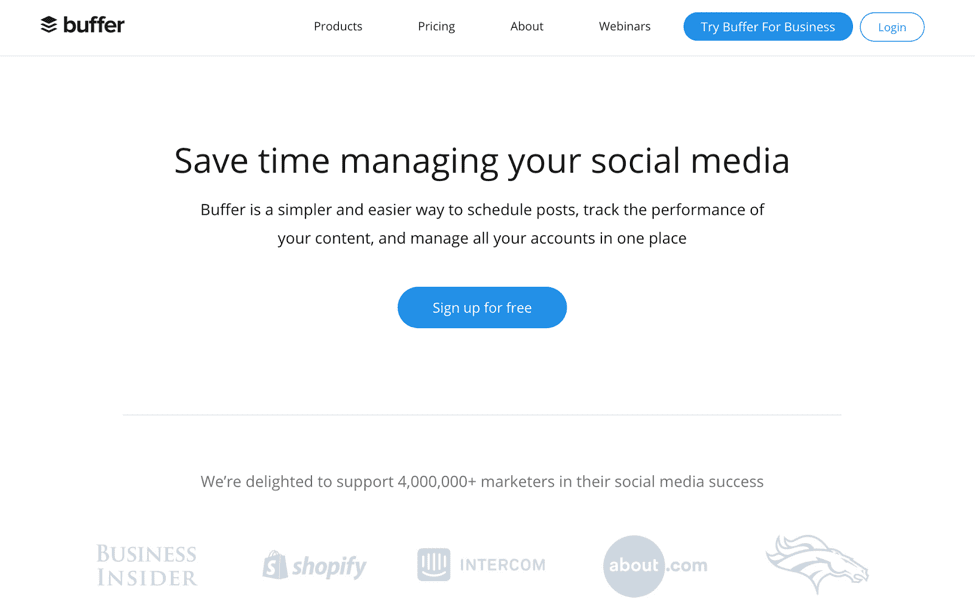
For example, rather than have an employee post every piece of content you create to social media in real-time, you can automate the process by taking advantage of software such as Buffer, to schedule posts for you in advance.

buffer

Not only does Buffer’s automation software take care of the tedious tasks related to publishing content, it also gives you access to helpful data analytics that can guide your content creation in the future. Not to mention, when automation software is taking care of publishing for you automatically, you have more time to create content, effectively scaling your marketing operations.

The same holds true for many other aspects of business that can be automated as well, such as:

  • Marketing automation for email marketing
  • Lead tracking and scoring
  • Payment processing
  • Accounting
  • Customer service automation
  • Small daily tasks that can be automated using tools like IFTTT

The more you invest in setting up automation to streamline processes now, the easier it will be to scale your business tomorrow.

2. Cloud Computing

Cloud computing enables all your IT computing services--such as, servers, storage, databases, networking, software and analytics--to be delivered in real-time over the internet.

The biggest benefit of implementing cloud computing in your business is its efficiency and scalability. With cloud computing, you can seamlessly expand your IT resources as your business grows.

And, as you continue to expand, cloud-based services can answer your needs for fluctuating bandwidth demands. Therefore, you won’t find yourself unable to operate when your business hits a higher capacity.

3. Long-Term Financial Perspective

Setting up your finances correctly from the get-go is imperative to ensuring your success as your business scales.

long-term financial perspective

In order for your business to survive in the long run, your revenue must exceed your costs. However, if you’ve already managed to master this and generate profit, don’t immediately whisk that money away from the business.

If you want to scale, you have to think long-term. Therefore, as you begin to generate profit, put some money aside in order to re-invest it into the business when you’d like to expand. This way you’ll be less inclined to find outside investors for scaling and can keep control over the majority of your business.

You can even invest a portion of your surplus profits in liquid investment classes so that when you don’t need the money, it will steadily increase in value. And, when you do need it to help you scale, you can liquefy the assets quickly and reinvest them in your business.

Many businesses invest in securities for a variety of reasons. The benefit to investing surplus profit is that your business won’t suffer from the risk of the securities decreasing in value. And, in the case that the securities increase in value, you generate even more money for your business.

4. Effective Sales Funnel

The bottom line for any business is sales. And, if you can manage to create an effective sales funnel, the sky’s the limit.

How can you do this?

Perfect every aspect of your sales funnel, from the value-driven lead magnet at the entrance to the email that closes the deal at the exit.

A typical sales funnel has 3 stages:

Awareness

The awareness phase is the one in which prospective customers become aware of a solution to what they’re seeking. This is where you need to attract prospects to your solutions. Creating a content marketing strategy is one of the most effective ways to do so. Awareness phase content can include white papers, ebooks or how-to videos, all that are relevant to your business’ offering and interesting to your target audience.

Evaluation

The evaluation phase is the one in which prospective customers compare and contrast products and solutions as they inch towards making a purchase decision. Marketing material for this phase should include webinars, case studies, or customer testimonials. These are all types of content that can help prospects make a more informed decision.

Decision

The decision phase is where a prospective customer finally decides what they would like to purchase. This is where your business has the opportunity to upsell or cross-sell products to them or send them incentives that will encourage them to be returning customers.

Every phase of your sales funnel must be thought out, tested and retested to determine the most optimal performance. Only then, can you utilize it effectively “on auto-pilot” to scale your business.


source https://www.smartinsights.com/digital-marketing-strategy/4-essential-elements-o/

Tuesday, 2 January 2018

How many CRO tests are marketers doing monthly?

Chart of the day: Most marketers are running 1-2 Conversion Rate Optimization tests, such as AB testing, every month.

It's worth noting though that around 7% also run 20 or more tests, the majority run no more than 4 tests per month.

It's no doubt testing is hugely important to marketers, I don't see to sell anyone the benefit of AB testing or Multivariate testing, but for those who'd like to know the difference, I've summarised below.

I've taken the following definitions from Dr David Travis who is a UX consultant, has produced a very popular UX course on Udemy and has a Psychology PhD. The definitions are from his Udemy course.

  • AB testing - a comparison of two designs, tested with live users and a large number of users. You can run tests until you have a "winner" for example, one which outperforms the other one statistically
  • Multivariate testing - where there are more than two versions involved in a test

What does this mean for you?

If you're not testing, now really is the time. Our briefing can help.

Importantly, this report is from 2017. I've posted this chart to encourage marketers to think about how much testing they have done in 2017, to look ahead at their testing plans for 2018. Remember - you can test anything and everything and testing can provide wealthy benefits from increases in revenues to returning customers.

Why not try testing the following:

  1. Homepage copy
  2. Ad copy
  3. Sales letter page copy
  4. Different copy throughout the checkout process
  5. Different versions of checkout
  6. Product pages (copy, images, video)

Regular testing can make a big impact, so make sure it's part of your digital marketing strategy for 2018.


source https://www.smartinsights.com/digital-marketing-strategy/many-cro-tests-marketers-monthly/